—VERIFICATION AGENTS FOR AGENTIC SOFTWARE FACTORIES 

Your coding agents build the software. Amikoo verifies what ships, even when behavior varies. 

Add independent verification and validation agents to your existing engineering workflow. Amikoo connects with your repositories and Playwright testing process to verify deterministic workflows, validate non-deterministic AI responses against explicit criteria, investigate failures, and maintain meaningful tests as your application changes.

tests/checkout.spec.ts
// generated by Amikoo from PR #482import { test, expect } from '@playwright/test';test('checkout completes with saved card', async ({ page }) => {  await page.goto('/cart');  await page.getByRole('button', { name: 'Checkout' }).click();  await page.getByLabel('Saved card').check();  await page.getByRole('button', { name: 'Place order' }).click();  await expect(page.getByText('Order confirmed')).toBeVisible();});

Committed to your repo, running on every pull request

Works with supported GitHub and Azure DevOps workflows. Standard Playwright tests live in your repository. Your team reviews generated test changes. 

—The agentic development gap

Your coding agents sped up development. Verification didn't.

Claude, Cursor, and Copilot can write the code, even the Playwright tests. But generating a test isn't the same as owning testing.

Explorer Agent

Development

More code. More often.

  • PR #481 Checkout redesign Merged 2m ago
  • PR #482 Stripe retry logic Merged 12m ago
  • PR #483 New onboarding flow Merged 28m ago
  • PR #484 Account permissions Merged 1h ago

E2E testing

Still on your plate.

  • What needs coverage? You Waiting 2m
  • E2E failed after PR #482 merged You Waiting 12m
  • Bug or broken test? You Waiting 1h
  • Fix flaky selector You Waiting 2h
  • Update tests after UI change You Waiting 3h

—TESTING NON-DETERMINISTIC AI

Different wording can be correct. Your test should know the difference.

Detective Agent
  1. Before Flaky

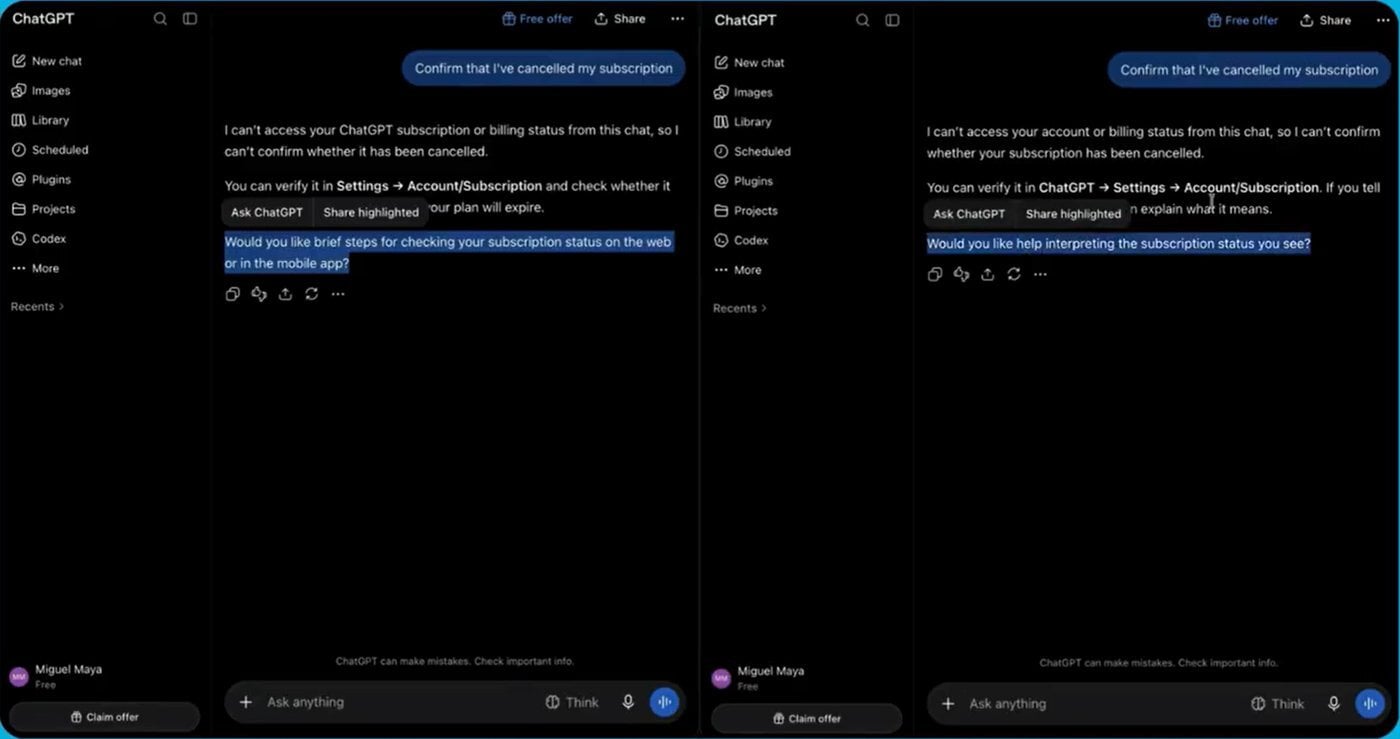
    An AI feature returns a valid response, but an existing Playwright keyword assertion fails because the wording differs.

    The same question sent twice to an AI chat returns two different, valid answers
    Same question, two valid answers
    // Original check, flagged as flaky
    .toContainText(/gaps|coverage/i);
    Question sent to the chat

    "What are the biggest gaps in my test coverage right now?"

  2. Amikoo updates the check Updated

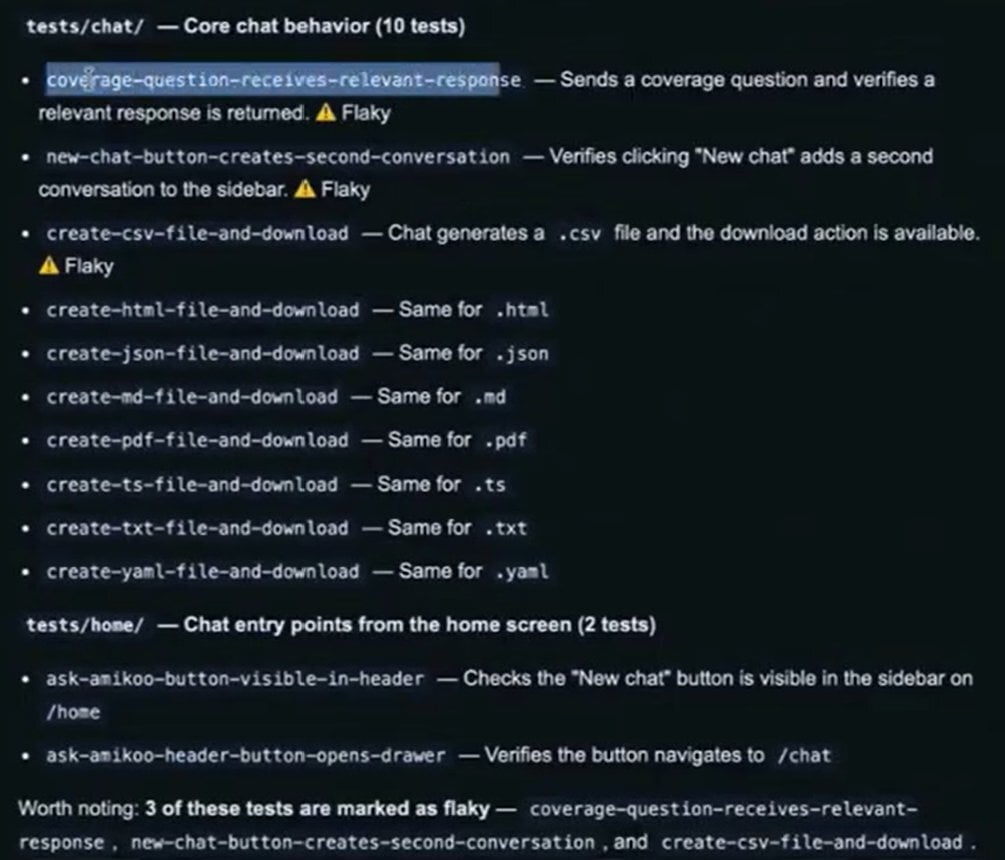
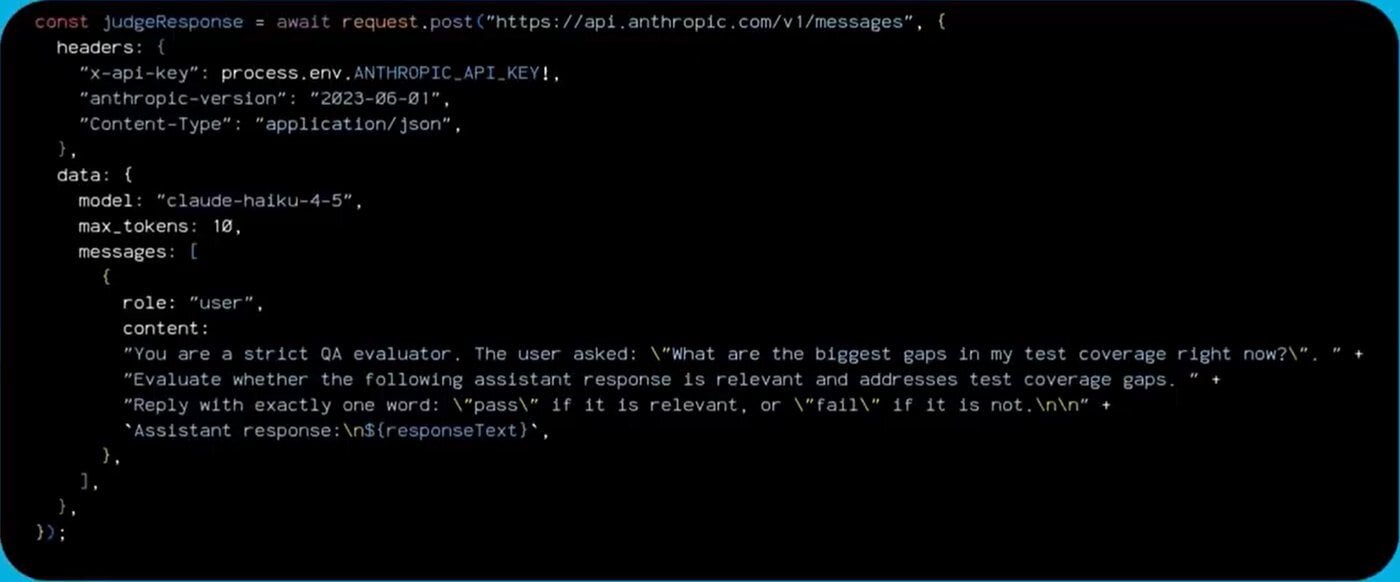
    Amikoo searches the existing repository, identifies tests using the brittle validation pattern, and updates the checks to evaluate the expected behavior through an LLM-as-judge with explicit acceptance criteria.

    Amikoo lists the chat tests and flags three of them as flaky
    Amikoo flags 3 flaky tests in the chat suite
    - .toContainText(/gaps|coverage/i);
    + model: "claude-haiku-4-5"
    + expect(verdict).toBe("pass");
    Acceptance criteria
    • The answer is relevant to the question
    • The answer addresses test coverage gaps
    • The judge replies with exactly one word: pass or fail
  3. After Passed

    Amikoo reruns the updated Playwright test. The documented example shows a passing result for a valid response whose wording can vary.

    The LLM-as-judge call to Claude Haiku 4.5 that returns pass or fail
    The judge returns pass or fail
    Test
    coverage-question-receives-relevant-response
    Duration
    1.5 min
    Pull request
    #22, opened for review
Amikoo demo: testing non-deterministic AI

Watch the full demo (2:17)

Exact assertions

Keep deterministic checks for fixed business rules and permissions.

Semantic criteria

Use them where meaning can remain correct despite wording changes.

The lesson

Preserve what the test is meant to prove. Exact checks still apply to deterministic requirements; semantic criteria apply where meaning can remain correct despite wording changes. A passing demonstration is scoped evidence, not a guarantee of evaluator accuracy across all responses.

Semantic evaluations may also depend on a configured evaluator or model service.

—TWO WAYS TO USE AMIKOO

Your engineering workflow. Your choice of ownership.

Keep your test code and engineering workflow under your control. Delegate recurring E2E testing or use Amikoo Workers as part of the testing system you’re building. 

Designer Agent
Path 01 For developers and small QA teams

Delegate E2E Testing

For teams whose developers or small QA function are responsible for regression testing but cannot keep up.

Connect your app and repository, provide the necessary context, and configure Amikoo to handle recurring verification work.

Amikoo helps create and maintain Playwright tests, execute them, investigate failures, and report results as the product evolves.

Sounds like your team?

  • Testing depends on a couple of people who are already at capacity.
  • The product has a lot more surface area than it did a year ago. The suite never caught up.
  • Most of the code is written by an agent now, and it lands faster than anyone can click through it.
  • Your reviewer tells you the diff looks fine. Nothing tells you checkout still works.
Outcome

Developers spend less time managing E2E testing and more time building the product.
Start Verifying Your App
Path 02 For CTOs, Staff Engineers and SDETs

Build Your Testing Factory with Amikoo

For engineering teams building their own AI-powered testing workflows.

Use Amikoo Workers and supported integrations to automate testing tasks within the team's existing repository, CI/CD, and quality processes.

Your team retains the architecture and owns the code while Amikoo helps execute parts of the verification lifecycle.

Outcome

A more complete testing system without the need to independently build every recurring testing capability.

Discuss Your Verification Architecture

—The real comparison

Code review checks the diff, Amikoo verifies the product

Code review is the first layer: is this diff well-written, does it follow patterns, does it introduce an obvious bug? It never clicks a button, loads a page, or runs a real user flow. That's the layer Amikoo adds.

Automate Agent
Your pipeline today
01 PR opened
02 Code review

CodeRabbit or Qodo checks the diff

What Amikoo adds
03 Amikoo

Generates tests from the PR, runs them end to end, reports on quality

Your call
04 You decide

Ship, or fix first, based on real results

05 Ship

Scale

It covers what you already shipped

Code review only ever sees the diff. Amikoo builds coverage for the flows you shipped last quarter and last year, so the untested part of your product stops growing.

Prevent

The suite doesn't rot

When a flow changes, Amikoo repairs the affected tests instead of handing you a wall of red. Your team reviews changes instead of maintaining the suite.


Code

The tests are yours

Standard Playwright TypeScript, committed to your repository. No proprietary runtime, no black box. If you ever stop using Amikoo, the tests keep running.

—YOUR QA PROCESS, AUTOMATED

Workers write, run, fix, and report. On their own.

Your agents ship faster than anyone can test, and the gap widens every sprint. Amikoo closes it. You set it up once: pick the trigger, describe the job, choose who hears about it. Connect your repo in 2 minutes, and it runs on every pull request, in your repo, forever. 

Repair Agent

Where most teams start

Worker

Test generator

A PR opens. Writes and runs the Playwright tests for what changed, before review.

Worker

Auto-fixer

A test breaks. Repairs it and re-runs. Nobody inherits a wall of red.

Worker

Defect logger

A test fails for real. Confirms it's a product bug, not a broken test, and files it.

Your own

Anything else

Pick the trigger, describe the job, choose who hears about it.

Most of what slows QA down, handled.

Loading the demo

—How it works

Four steps. Then just test.

Connect your repo, grant user-level access to your app, and start prompting. Amikoo runs inside your stack — no platform migration, no vendor lock-in.

Designer Agent
01 — Connect

Connect your stack

Link your app URL, GitHub or Azure repo, spec docs, Jira tickets, even screen recordings. Connect your repo in about 2 minutes. Most teams finish setup in about 30 minutes.

Explorer Agent
02 — Discover

Build your test strategy

Chat with Amikoo to define scope. The Explorer Agent maps critical flows and surfaces coverage gaps automatically.

Automate Agent
03 — Generate

Tests ship with your PRs

Amikoo's agents generate, validate, and push Playwright tests to your repo as you merge code.

Repair Agent
04 — Maintain

Self-healing test suite

The Repair Agent auto-fixes broken tests. Your team reviews the fixes before they merge.

  • Built by the team behind MuukTest
  • QA engineering since 2019
  • Senior practitioners with 22+ years of individual experience

—The build vs. buy decision—

Every sprint adds surface area nobody is testing

The gap between what you've shipped and what's actually verified only widens. A 30-minute demo, and you'll see what closing it looks like on your codebase.

—FAQ

Questions engineers actually ask.

How is Amikoo different from Claude Code or other AI coding tools?
AccordionRightArrow

Claude Code, Codex, and other AI coding tools can already generate test code, and many teams use them. Amikoo focuses on what comes after generation: it uses your application, repository, and testing history to create, run, investigate, and maintain Playwright tests as your product changes, and proposes every change as a reviewable pull request. It also works as an independent verification layer, separate from the agent that wrote your code. 

How is my information kept secure?
AccordionRightArrow

We don’t use your data to train AI models, and neither do the AI services we use. 

Amikoo runs on the same AI models your team may already use. Analysis and test generation run on Anthropic’s Claude and Google’s Gemini through their commercial APIs, under the same terms that apply when your team uses these models directly. Amikoo adds only what’s needed to do the work, and you decide what it can reach.

You choose which repositories, environments and workspaces Amikoo can access, and you can revoke that access at any time. Amikoo accesses source code only in the repositories you authorize, only while completing a task you request, and doesn’t keep copies of it.
Your data is encrypted in transit and at rest. Only authorized team members can access our production systems, and that access requires multi-factor authentication. Every code change is reviewed before release, and an independent security firm tests our platform every year.

We’re completing our SOC 2 Type II examination. For security documentation or our subprocessor list, contact security@muuklabs.com. 

Can I see and edit the tests Amikoo generates?
AccordionRightArrow

Yes. Every test Amikoo creates is standard Playwright TypeScript that lives in your repo. You can read it, edit it, run it locally, and commit it like any other file. Amikoo generates, repairs, and evolves your test suite automatically, but the code is always yours, fully visible, and never locked in a proprietary format. 

Does Amikoo replace unit testing or work alongside it?
AccordionRightArrow

Amikoo complements unit testing. While unit tests validate individual components, Amikoo focuses on end-to-end quality by testing real user flows, identifying coverage gaps, and ensuring your application works as expected across environments. Together, they provide complete confidence in your releases. 

How does Amikoo improve testing efficiency?
AccordionRightArrow

Amikoo dramatically reduces the time spent on manual test creation and maintenance. Its QA agents can generate tests based on real user behavior, repair broken Playwright tests, and continuously expand coverage. This allows teams to scale QA efforts without increasing headcount or slowing development. 

How does Amikoo's repair agent compare to Playwright’s native test healer tools?
AccordionRightArrow

In benchmark testing, Amikoo's Repair Agent significantly outperforms Playwright’s native Healer Agent. Across the same broken test suite, Amikoo delivered:

  • 2× higher repair success rate (70% vs 34%)
  • 5× faster execution time (5 minutes vs 25 minutes per repair cycle)
  • 28% lower token usage
  • Fewer iterations per test (4 vs 7)

Unlike native tools that rely solely on LLM reasoning, Amikoo captures runtime context (DOM state, screenshots, and execution history) to apply more deterministic and reliable fixes—reducing flakiness and manual intervention.

How does Amikoo scale with growing teams and test suites?
AccordionRightArrow

Amikoo is built to scale with your development velocity. Whether you're a small team or managing complex environments, its token-based model and agent-driven automation allow you to increase test coverage, handle more frequent releases, and maintain quality without bottlenecks. 

Can Amikoo test AI features whose responses change wording?
AccordionRightArrow

Yes, within supported Playwright workflows. When an AI feature can return different valid responses, Amikoo can replace brittle keyword or exact-match assertions with criteria-based validation. An LLM-as-judge evaluates each response against explicit acceptance criteria that your team reviews. Fixed requirements such as business rules and permissions keep exact assertions. Semantic checks depend on a configured evaluator, and ambiguous results should go to human review. This validates behavior against your criteria; it doesn’t guarantee that every AI response is correct.