


Focus on what matters
Every day your team manually ports Selenium tests is a day of senior engineer time burned on work a machine can do in hours.

Skip the build-vs-buy trap entirely
You don't need more engineers, a custom Claude pipeline, or a team committed to QA infrastructure maintenance forever.

Playwright coverage from day one
Not after six months of migration. Tests are live, in your repo, running in CI/CD from the start.

Predictable, lower pricing
No surprise AWS Bedrock bills, no loaded salaries on a migration project. More than 10x cheaper than the DIY alternative.

Full visibility before you commit
Connect a repo, run the migration. You see exactly which tests were generated, what coverage moved, and what's still missing.

01 — Connect
Connect your stack
Link your Selenium/Java repo, app URL, spec docs, Jira tickets, even screen recordings. 15 minutes to start your Playwright migration.

02 — Discover
Map your Selenium suite
Chat with Amikoo to define migration scope. The Explorer Agent maps your existing Selenium flows and surfaces coverage gaps before translation begins.
03 — Generate
Selenium translated to Playwright
6 specialist agents translate your Selenium tests into idiomatic Playwright (Page Object Model, BDD, or your own conventions) and push directly to your repo.
04 — Maintain
Self-healing Playwright suite
The Repair Agent auto-fixes broken Playwright tests post-migration. Your suite stays in sync as you ship, no manual upkeep required.

.png "Amikoo chat prompt")
.png "Untitled design (58)")

Explores Product, GitHub, Architecture
.png?width=40&height=40&name=Untitled%20design%20(58).png)

Reviews Playwright Test Code & History

Pulls in User Context



Creates & Pushes Executable Test Code
.png?width=380&height=467&name=Untitled%20design%20(55).png "Untitled design (55)")

How long does it take to migrate from Selenium to Playwright?

A manual Selenium to Playwright migration typically takes 6–12 months for a suite of 500+ tests, at an average of 1 test per hour for complex Java/Selenium suites. Teams using DIY AI approaches with tools like Claude or ChatGPT reduce this to 3–5 months, but still need to build and maintain the migration pipeline themselves. With a purpose-built migration tool like Amikoo, most teams complete the same migration in days to weeks.
Can I use Claude or ChatGPT to migrate my Selenium tests to Playwright?
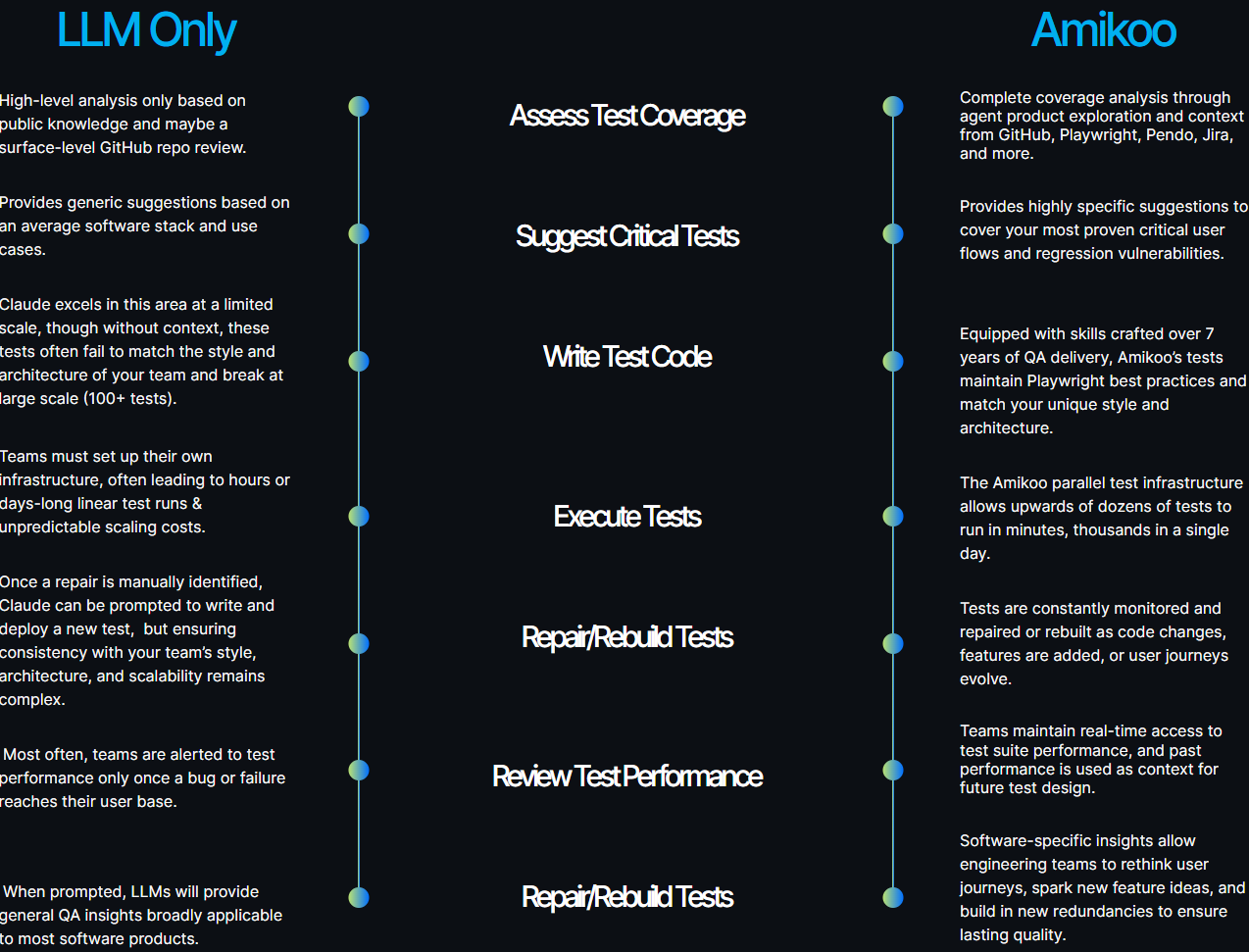
Claude and ChatGPT can write individual Playwright tests, but they can't manage a full Selenium migration end-to-end. The core limitations are: they process your entire repository on every call (causing token costs to spiral), they have no repair layer to fix failures after a deploy, and the same model writing your code also writes your tests, creating a validation problem. Purpose-built tools like Amikoo use 6 specialist agents and 51 custom AI tools specifically designed for QA, using ~70% fewer tokens than raw Claude.
How much does a Selenium to Playwright migration cost?
The cost depends heavily on the approach. A manual migration of a 500-test suite requires approximately 500+ engineer-hours at loaded US salaries; that's $75,000–$150,000 in labor, not including new regressions introduced during translation. A DIY AI approach using Claude or similar tools costs $1M+ in year one, accounting for 3–4 engineers to build and maintain the pipeline, plus API costs. A purpose-built migration tool like Amikoo costs a fraction of either alternative, more than 10x cheaper than raw Claude usage, with no infrastructure to build or maintain. Most teams see ROI within the first sprint.
What's the difference between manually rewriting Selenium tests and using an AI migration tool?
Manual rewriting means an engineer reads each Selenium/Java test and rewrites it in TypeScript/Playwright by hand - slow, error-prone, and expensive at scale. An AI migration tool automates the translation: it reads your existing test files, maps coverage, rewrites tests into idiomatic Playwright, and handles post-migration failures automatically. The key differences are speed (days vs. months), coverage integrity (automated mapping vs. human judgment), and ongoing maintenance (auto-repair vs. manual investigation every time a test breaks). Not all AI migration tools are equal; tools built on raw LLMs like Claude require you to assemble the pipeline yourself, while purpose-built tools like Amikoo include discovery, translation, validation, and repair as integrated agents.
Do I need to rewrite my entire Selenium test suite to migrate to Playwright?
Not necessarily, but for most teams, a full migration is the right call. Maintaining a hybrid Selenium/Playwright suite creates long-term technical debt: two frameworks to update, two CI/CD configurations to maintain, and two sets of dependencies to manage. A phased migration is possible, but it extends the transition period and keeps your team context-switching between frameworks. The reason most teams avoid full migration is the perceived time cost, not the technical complexity. With an automated migration tool like Amikoo, translating the entire suite at once is faster than a phased manual approach, and the Repair Agent handles failures as they surface post-migration. For large Java/Selenium backlogs specifically, automated full migration is almost always more efficient than partial rewrites.
Can I see and edit the tests Amikoo generates?
Yes. Every test Amikoo creates is standard Playwright TypeScript that lives in your repo. You can read it, edit it, run it locally, and commit it like any other file. Amikoo generates, repairs, and evolves your test suite automatically, but the code is always yours, fully visible, and never locked in a proprietary format.