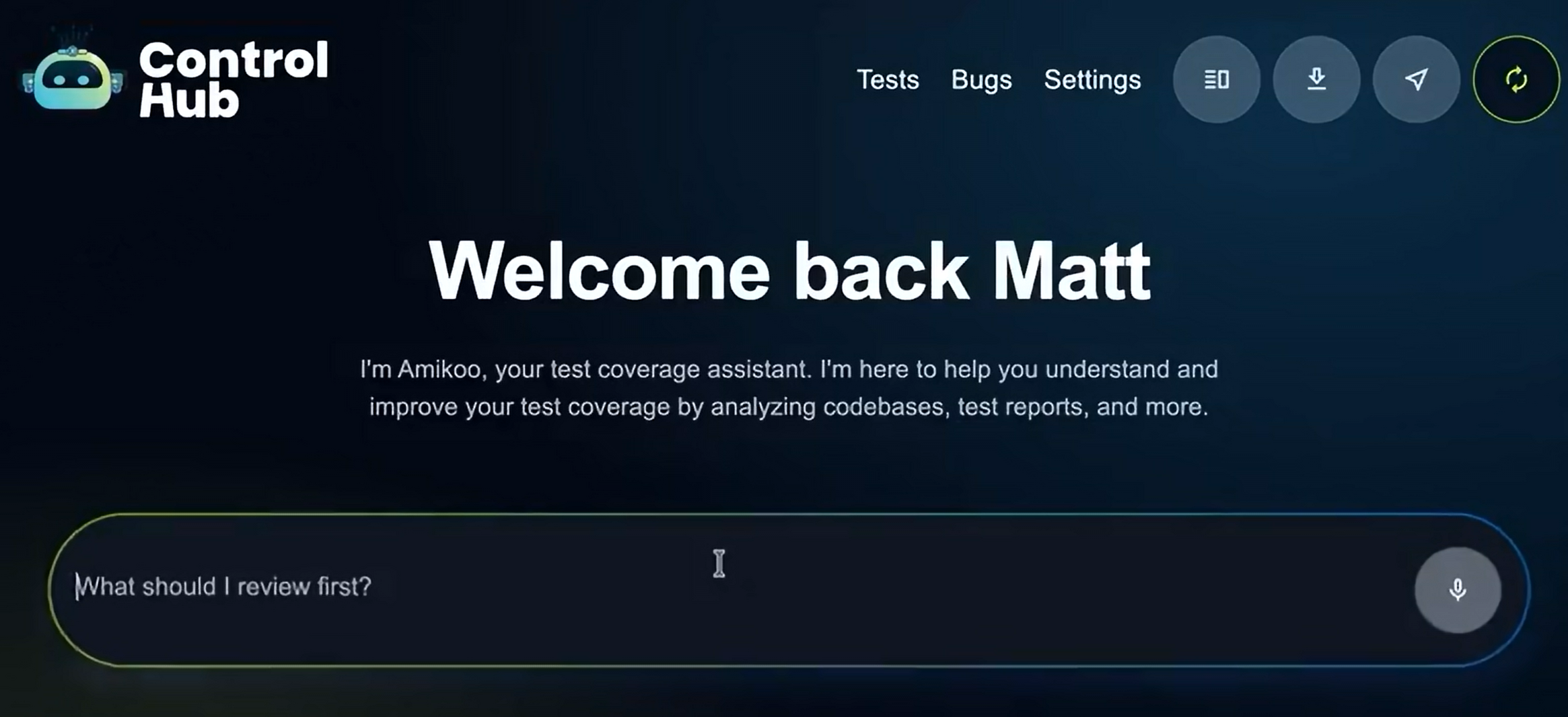
For a developer who has inherited end-to-end testing on top of their regular workload without a dedicated SDET or QA function to lean on, the real question isn't "can this tool write a test," it's "does this tool close the loop, by running that test against a real build, telling you why it failed, and doing it every time code changes, without a human babysitting the pipeline." Most tools in this space fall into one of two categories: ones that generate test code you still have to wire into your pipeline, and ones that generate, execute, diagnose, and report on tests as part of your actual CI/CD run. The difference matters because a test that never runs in CI catches nothing. Running in CI isn't the only way to close that loop. Some tools run tests in their own cloud, so the team doesn't have to wire anything into a pipeline at all. What matters is that tests run on real builds every time code changes, and failures come back diagnosed. Running in CI isn't the only way to close that loop. Some tools run tests in their own cloud, so the team doesn't have to wire anything into a pipeline at all. What matters is that tests run on real builds every time code changes, and failures come back diagnosed.
TL;DR
- Code-generation tools produce test scripts; CI-native tools generate, execute, triage, and report results automatically on every pull request.
- The giveaway is whether the tool needs a human to copy output into a pipeline, or whether it's already wired into GitHub/Azure DevOps triggers.
- Self-healing and failure classification (product defect vs. test issue vs. environment issue) only matter if the tool actually runs tests repeatedly in CI, not just once.
- Playwright has become the default target format because it's portable, multi-browser, and not locked to one vendor's runtime.
- When evaluating a CodeRabbit alternative or any AI QA tool, ask what happens after the test is written, that's where real tools and demo tools diverge.
What's the Actual Difference Between Code Generation and CI-Native Testing?
Code generation means a tool produces a test script, usually after you describe a user flow or point it at your app. CI-native testing means that script is executed automatically inside your continuous integration pipeline, on a trigger like a pull request, with results reported back without a human re-running anything manually. The distinction sounds small until you trace what happens next: a generated script sitting in a folder has zero verification value until something actually executes it against a live build and tells you whether it passed. Most ai powered test automation tools do the first part well. Fewer do the second part reliably, because running tests in CI requires handling flaky environments, timing out gracefully, and classifying failures, problems that have nothing to do with writing code and everything to do with operating a pipeline [saucelabs.com].
Why Do So Many "AI Testing Tools" Stop at Code Generation?
Building a model that writes a Playwright script from a natural-language prompt is a narrower engineering problem than building a system that runs reliably across hundreds of pull requests a month. Generating code is a single inference call. Running it in CI means handling test infrastructure, parallel execution, retries, and result reporting as ongoing operational work, not a one-time output [testguild.com]. That's a meaningful reason the market has split into tiers: general-purpose coding assistants like Claude or Codex can write a solid Playwright test in seconds. That's what they're built for: writing code. Owning the execution loop, retry logic, and failure triage that a pipeline needs is a different job. A tool review from 2026 testing over 40 AI test automation products found that the products which "actually work, no hype" were consistently the ones with dedicated CI integration, not just generation capability [testguild.com].
How Do You Spot a Tool That Only Writes Code?
Ask three questions before adopting anything that calls itself an AI testing tool, because the answers expose whether it's a code generator wearing a QA label.
- Does it trigger automatically on a pull request, or do you have to manually invoke it? A real closed-loop tool fires on a trigger, such as a pull request opening, a GitHub Action, or an Azure DevOps pipeline event, without someone remembering to run it.
- Does it tell you why a test failed, or just that it failed? A "wall of red" with no diagnosis forces a developer to manually investigate whether a failure is a real product bug, a stale test, or a flaky environment, which defeats the point of automating the check in the first place.
- Does the output live in your repo as portable code, or only inside the vendor's platform? Portable Playwright TypeScript keeps running even if you switch tools; proprietary formats tie you to one vendor's runtime [dev.to].
This is also where the term self-healing test automation gets used loosely. Self-healing only has value if the tool first determines whether a failure is a genuine product defect, a test that's now out of sync with the app, or an environment hiccup, and repairs only the cases that are actually test issues. A tool that "auto-fixes" every red test regardless of cause isn't diagnosing anything, it's just suppressing signal.
Why Has Playwright Become the De Facto Standard for CI-Native Tools?
Playwright offers multi-language support, cross-browser testing across Chromium, Firefox, and WebKit, built-in auto-waiting, and parallel execution. Those auto-waiting and parallel-execution features matter specifically in a CI context: flaky tests caused by timing issues are one of the most common reasons automated suites get disabled or ignored, and a framework that waits intelligently for elements to be ready reduces that noise. That's a core reason teams running a selenium to playwright migration or a cypress to playwright migration tend to see fewer false failures once the move is complete. It's also why most serious AI testing tools, whatever they generate code with, output Playwright as the final format rather than inventing a proprietary scripting language.
How Does CI-Native Execution Actually Work Under the Hood?
Major CI/CD platforms like GitHub Actions, CircleCI, and Azure DevOps treat AI-generated tests exactly like human-written tests: they use standard token-based permissions for execution and standard artifact upload actions with configurable retention policies for storing results and logs. That's a useful mental model: a CI-native testing tool isn't doing anything exotic from the pipeline's perspective, it's committing standard code, triggering it on the same events a human-written test would use, and uploading results the same way. The "AI" part is upstream, in deciding what to test and diagnosing why something broke, not in how the pipeline executes it. This is also why Amikoo generates standard Playwright TypeScript committed directly to a customer's own repository rather than running in a proprietary format: the tests keep executing through normal CI mechanics even if a team changes vendors later.
What Does Good Failure Triage Actually Look Like?
Good triage means every failed test gets classified before anyone acts on it: is this a real product defect, a test that fell out of sync with an app change, or a flaky environment? Treating all three the same way is how teams end up either ignoring a red suite entirely or burning hours chasing non-issues. In Amikoo's workflow, Amikoo handles the testing work, from generating and running tests to diagnosing each failure, repairing test issues, and reporting real defects. People make the final release-risk decision, based on the evidence Amikoo reports. That split matters for automated regression testing tools broadly: automation should reduce the volume of noise a human has to sort through, not just increase the volume of output a human has to review.
| Capability | Code-generation-only tools | CI-native testing tools |
|---|---|---|
| Produces test code | Yes | Yes |
| Triggers automatically on PR | Rarely, needs manual invocation | Yes |
| Executes against live builds | Not by default | Yes, every run |
| Classifies failure cause | No | Yes, in mature tools |
| Output format | Varies, sometimes proprietary | Often standard Playwright |
How Should You Evaluate a CodeRabbit Alternative or Similar AI QA Tool?
CodeRabbit and similar tools operate at the code review layer, analyzing diffs for quality and style issues before merge. That's a different job from end-to-end verification, which confirms the application actually behaves correctly when a real user clicks through it. If you're looking for a CodeRabbit alternative specifically to cover E2E gaps, the evaluation criteria shift: does the tool run real browser flows, not just read code, and does it report on product behavior, not just code hygiene? Several products in this space take different architectural approaches worth understanding. QA Wolf runs as a managed service on its own cloud infrastructure with parallel execution. Momentic stores tests as YAML with a hybrid local/cloud model for AI locator resolution. Checksum generates and self-heals Playwright tests from real user data via a cloud background agent. Meticulous replays recorded user sessions with a deterministic browser and mocked network traffic to eliminate flakiness entirely. Each represents a different bet on where automation should sit between code generation and live execution, and the right fit depends on whether your team wants a managed service, a hybrid authoring tool, or something that commits plain code to your own repo.
Frequently Asked Questions
What's the main sign a testing tool only generates code instead of running it in CI?
It requires manual steps to move generated scripts into your pipeline rather than triggering automatically on events like a pull request.
Does self-healing test automation mean failures are hidden?
No, properly implemented self-healing diagnoses whether a failure is a product defect, test issue, or environment issue first, and only repairs the test-issue cases.
Why do most CI-native tools output Playwright specifically?
Playwright supports multiple languages, cross-browser testing, auto-waiting, and parallel execution, and produces portable code that isn't locked to a single vendor's runtime.
Is a Cypress to Playwright migration worth it for CI reliability?
Teams commonly pursue it to reduce flaky failures caused by timing issues, since Playwright's auto-waiting behavior addresses a common source of false failures in CI.
Do AI-generated tests need special handling in GitHub Actions or Azure DevOps?
No, major CI/CD platforms treat AI-generated tests the same as human-written ones, using standard permissions and artifact handling.
How does Amikoo fit into this code-generation vs. CI-native distinction?
Amikoo is on the closed-loop side. It generates standard Playwright TypeScript tests committed to your own repository, runs them in Amikoo's cloud or in your existing pipeline, and diagnoses each failure as a product defect, test issue, or environment issue. Teams set up Workers, automations triggered by events like a pull request opening, so this happens without anyone starting it. Each cloud run returns the result, the duration, and a video of the run.
About Amikoo
Amikoo is an AI agent by MuukLabs that owns end-to-end verification for web applications. Developers connect their app and repository in about 30 minutes. From then on, on every pull request, Amikoo understands the change, determines which user flows need verification, creates or updates standard Playwright TypeScript tests in the team's own repository, runs them, diagnoses each failure as a product defect, test issue, or environment issue, and reports real defects. It's built for fast-shipping teams, often using coding agents like Claude Code or Cursor, where E2E testing has fallen on developers and the current workflow can't keep up. Amikoo complements coding agents rather than replacing them: AI writes and reviews the code, Amikoo verifies the product actually works. It connects to GitHub and Azure DevOps, with Bitbucket and GitLab support in progress, with no proprietary runtime or lock-in. MuukLabs also offers MuukTest, an expert-backed services brand under the same parent company, for teams that want hands-on QA support alongside the platform.
If your pipeline has tests that get written but never reliably tell you what's actually broken, it's worth checking whether the tool is generating code or genuinely closing the loop. Visit https\://amikoo.ai/ to see how Amikoo handles that difference on every pull request.