The true cost of a missed production bug is rarely the number in the bug tracker. It is the sum of engineering hours spent on emergency triage, the revenue lost while the issue is live, the support tickets it generates, and the customer trust it quietly erodes. Production bugs can cost thousands of dollars once remediation time, lost revenue, and customer churn are factored in, and that figure climbs fast for anything customer-facing or payment-related. For a fast-shipping web team where end-to-end testing has landed on one developer's plate instead of a dedicated QA function, the question isn't whether bugs will reach production. It's how to calculate what that's actually costing, and what it would be worth to catch more of them before release.
TL;DR
- A production bug's true cost combines detection time, engineering hours, lost revenue, and customer churn, not just the fix itself.
- Production bugs take meaningfully longer to resolve than issues caught pre-release, due to emergency triage and deployment coordination.
- End-to-end test suites often miss many production bugs, largely because scripted test paths miss real-world variable conditions.
- Test automation investment tends to deliver measurable returns through reduced incident costs and freed engineering time.
- Amikoo writes Playwright tests for pull requests through Workers the team sets up, then runs, diagnoses, and repairs them, aimed at teams where a developer is carrying E2E testing without the bandwidth to keep up.
Amikoo is built by MuukLabs around a specific problem: fast-shipping engineering teams, often leaning on coding agents like Claude Code or Cursor, where end-to-end testing has fallen on a developer who cannot keep pace with release velocity. This article draws on that focus to walk through how to actually price a missed bug and what closing the coverage gap is worth.
What Does a Production Bug Actually Cost?
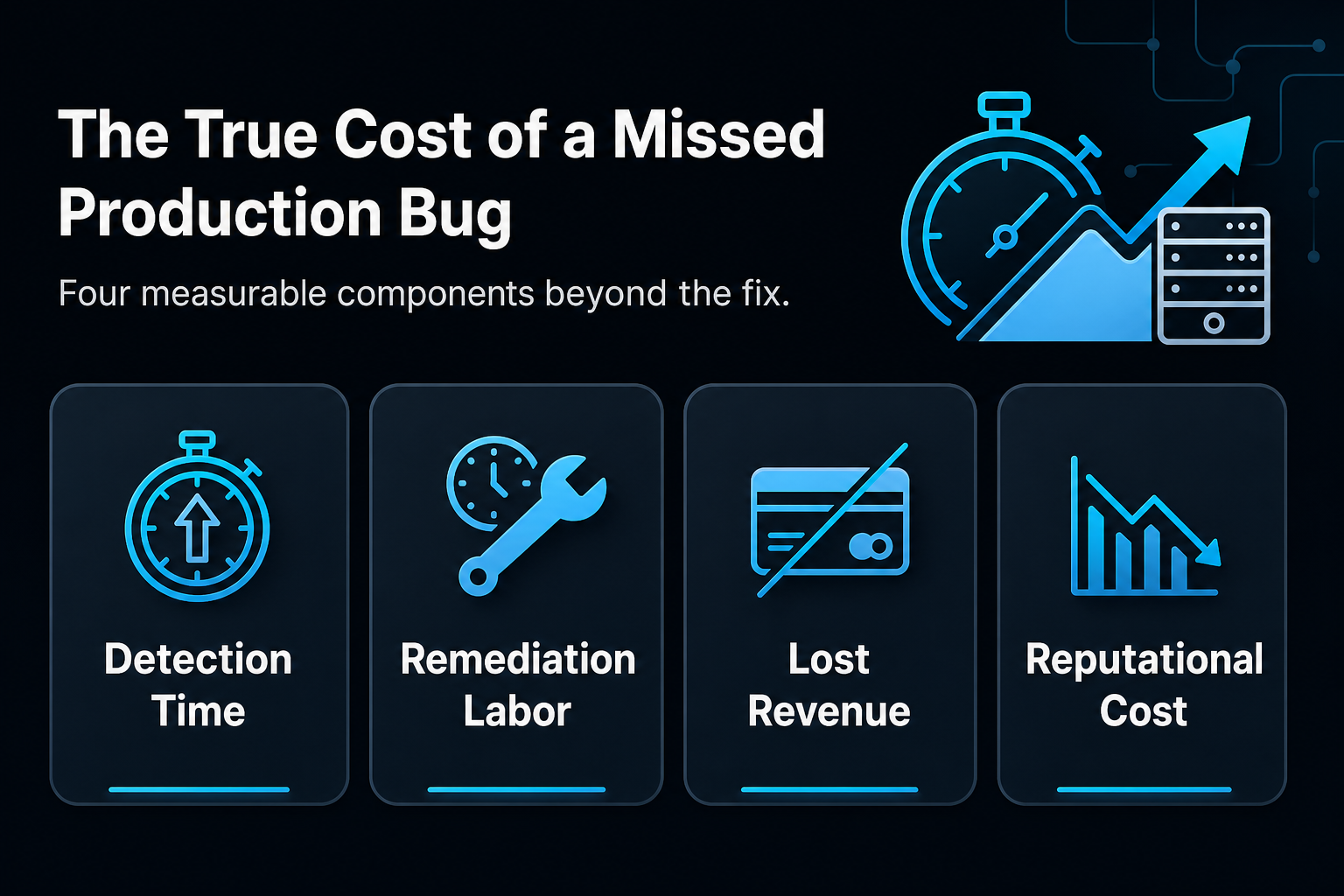
A production bug's cost is the sum of four components: detection time, remediation labor, lost revenue during the incident, and downstream customer impact. Each of these is measurable, which is exactly why "the bug cost us a lot" is an unsatisfying answer when a budget conversation comes up.
- Detection time: how long the bug was live before anyone noticed, often driven by monitoring gaps rather than testing gaps.
- Remediation labor: engineering hours spent on triage, root-causing, fixing, re-testing, and deploying a patch, usually under time pressure.
- Lost revenue: transactions that failed, checkouts abandoned, or users who churned during the window the bug was active.
- Reputational cost: harder to quantify, but real, support ticket spikes, negative reviews, and reduced trust in the next release.
Production bugs can be expensive to resolve: the typical cost includes both the engineering time to fix and deploy a patch and the business impact that occurs while the bug is live. That number varies widely depending on how long the bug escaped detection and what part of the product it affects. A bug in a checkout flow or an authentication path can cost far more, both in direct revenue and in the support load it generates.
How Do You Calculate the True Cost of a Missed Bug?
Calculating true cost means building a simple formula from the components above rather than guessing at a lump sum. The structure looks like this:
| Cost Component | How to Estimate It |
|---|---|
| Detection + resolution time | Hours from first report to deployed fix, multiplied by blended engineering hourly cost |
| Opportunity cost | What the engineers pulled into triage would otherwise have shipped |
| Lost revenue | Affected transaction volume x conversion drop x average order value, for the duration the bug was live |
| Support cost | Ticket volume increase x average handling cost |
| Churn risk | Estimated percentage of affected users who don't return, multiplied by customer lifetime value |
The resolution-time line item deserves attention because it's the multiplier that makes production bugs so much more expensive than bugs caught earlier. Production bug resolution typically takes significantly longer than the same class of issue caught during pre-release testing, due to emergency triage and deployment coordination overhead. That gap is the core argument behind the well-known "cost curve" in software quality: a defect found during code review might take minutes to fix, the same defect found in production can take days, once you count the coordination overhead alone.
Why Do So Many Bugs Still Reach Production?
Most bugs reach production because the testing that exists checks the paths teams remembered to script, not the paths users actually take. Scripted end-to-end tests run clean, predictable paths in controlled environments. Real users don't behave that way: they double-click buttons, use the back button mid-transaction, run outdated browser extensions, and combine inputs no test author anticipated.
That mismatch shows up in practice: many end-to-end test suites miss significant portions of production bugs, largely because they're built to validate known flows rather than probe for the unscripted ones. This isn't a testing failure so much as a coverage design problem: teams write tests for the features they just shipped and rarely circle back to test the surface area that shipped six months ago without incident, until it breaks.
For a developer who owns testing on top of their actual engineering work, this compounds. Every sprint adds new flows to maintain, and there's no time budget to go back and build coverage for what's already live. The result is a growing blind spot that tracks almost exactly with how fast the team ships. That's also why coverage of older flows needs to be visible, not assumed. Amikoo, for example, can email a weekly coverage report that flags previously shipped flows with no tests.
What Is Prevention Actually Worth?
Prevention's value is the cost of the bugs it stops multiplied by how many it catches before release, measured against what the testing investment costs to run. This is the software testing ROI calculation, and it's more favorable than most engineering teams assume once detection-time savings are included, not just the fix itself.
Test automation investment tends to deliver measurable returns through reduced production incident costs and engineering time freed from manual regression testing that can go back into feature work. The math tends to favor prevention even before counting the harder-to-quantify reputational cost of a bug reaching real users.
This is also where the choice of testing framework starts to matter at a technical level, not just a philosophical one. Playwright has become a widely adopted framework for end-to-end testing, valued for its direct browser communication, built-in auto-waiting behavior, and native cross-browser support, advantages that reduce the flaky-test problem that undermines trust in automated suites. A test suite that fails for reasons unrelated to the product (timing issues, environment flakiness) trains teams to ignore failures, which defeats the purpose of having the suite at all.
How Does a Lower Defect Escape Rate Change the Math?
A lower defect escape rate, the percentage of bugs that make it past testing into production, directly reduces every cost line item in the calculation above. Fewer escapes mean fewer costly emergency fixes, fewer lost-revenue windows, and fewer support spikes. It's the single metric that ties testing investment back to the dollar figures finance actually cares about.
Reducing escape rate isn't just about writing more tests. It's about keeping the tests you have accurate as the product changes underneath them. A test suite that goes stale, failing on every PR because the UI moved rather than because the feature broke, creates a "wall of red" that teams learn to click through without reading. That's arguably worse than no suite at all, because it burns trust in the signal.
This is the specific gap Amikoo is built to close. Teams set up Workers that tell Amikoo what to do and when, like writing the missing standard Playwright TypeScript tests whenever a pull request opens, directly in the team's own repository. Tests run either in the team's own CI/CD pipeline or in Amikoo's cloud. When a test fails, Amikoo's Repair Agent diagnoses whether the failure is a product defect, a test issue, or an environment issue before attempting any repair, repairs only test issues, and files real defects straight into the team's tracker, like GitHub issues or Jira. That diagnose-first step matters: a self-healing suite that patches a test without first checking whether the underlying feature actually broke risks masking a real defect rather than fixing a false alarm. In internal benchmarks against Playwright's native Healer Agent, the Repair Agent achieved 2x the repair success rate (70% vs. 34%) and 5x faster repair cycles (5 vs. 25 minutes) while using 28% fewer tokens; these are internal, benchmark-specific results, not independently verified. Humans still make the final call on release risk; Amikoo supplies the evidence that call is based on.
Frequently Asked Questions
What's the average cost of a single production bug?
Production bugs can cost thousands of dollars once remediation time, lost revenue, and customer churn are factored in, though the exact figure varies widely depending on severity and how long the bug escaped detection.
Why do production bugs take so much longer to fix than bugs caught earlier?
Production bug resolution typically involves emergency triage, cross-team coordination, and deployment scheduling, which adds significant overhead compared to issues caught in review or pre-release testing.
Is test automation actually worth the investment?
Test automation investment tends to deliver measurable returns through reduced production incident costs and freed-up engineering time, though the exact ROI depends on implementation and team context.
What makes Playwright a common choice for test automation?
Playwright's architecture includes direct browser communication, built-in auto-waiting, and native cross-browser support, technical traits that reduce flaky test failures compared to older frameworks.
What does "self-healing" test automation actually mean?
It means a system can detect when a test fails and attempt to update it automatically. Done responsibly, that update only happens after the system diagnoses whether the failure stems from a real product defect, a brittle test, or an environment issue, rather than auto-patching every failure.
How quickly can a team get AI test automation running?
With Amikoo, developer setup, connecting the app and repository, takes about 30 minutes. That's handoff time, not a claim about how long a full test suite takes to run.
About Amikoo
Amikoo is an AI QA agent by MuukLabs that owns end-to-end verification for web applications. Developers connect their app and repository in about 30 minutes. From then on, on every pull request, Amikoo understands the change, determines which user flows need verification, creates or updates standard Playwright TypeScript tests in the team's own repository, runs them, diagnoses each failure as a product defect, test issue, or environment issue, and reports real defects. It's built for fast-shipping teams, often using coding agents like Claude Code or Cursor, where E2E testing has fallen on developers and the current workflow can't keep up. Amikoo complements coding agents rather than replacing them: AI writes and reviews the code, Amikoo verifies the product actually works. It connects to GitHub and Azure DevOps, with Bitbucket and GitLab support in progress, with no proprietary runtime or lock-in. MuukLabs also offers MuukTest, an expert-backed services brand under the same parent company, for teams that want hands-on QA support alongside the platform.
If your team is shipping fast and the coverage math above looks uncomfortably familiar, it's worth seeing what closing that gap actually looks like. Visit https://amikoo.ai/ to learn more.