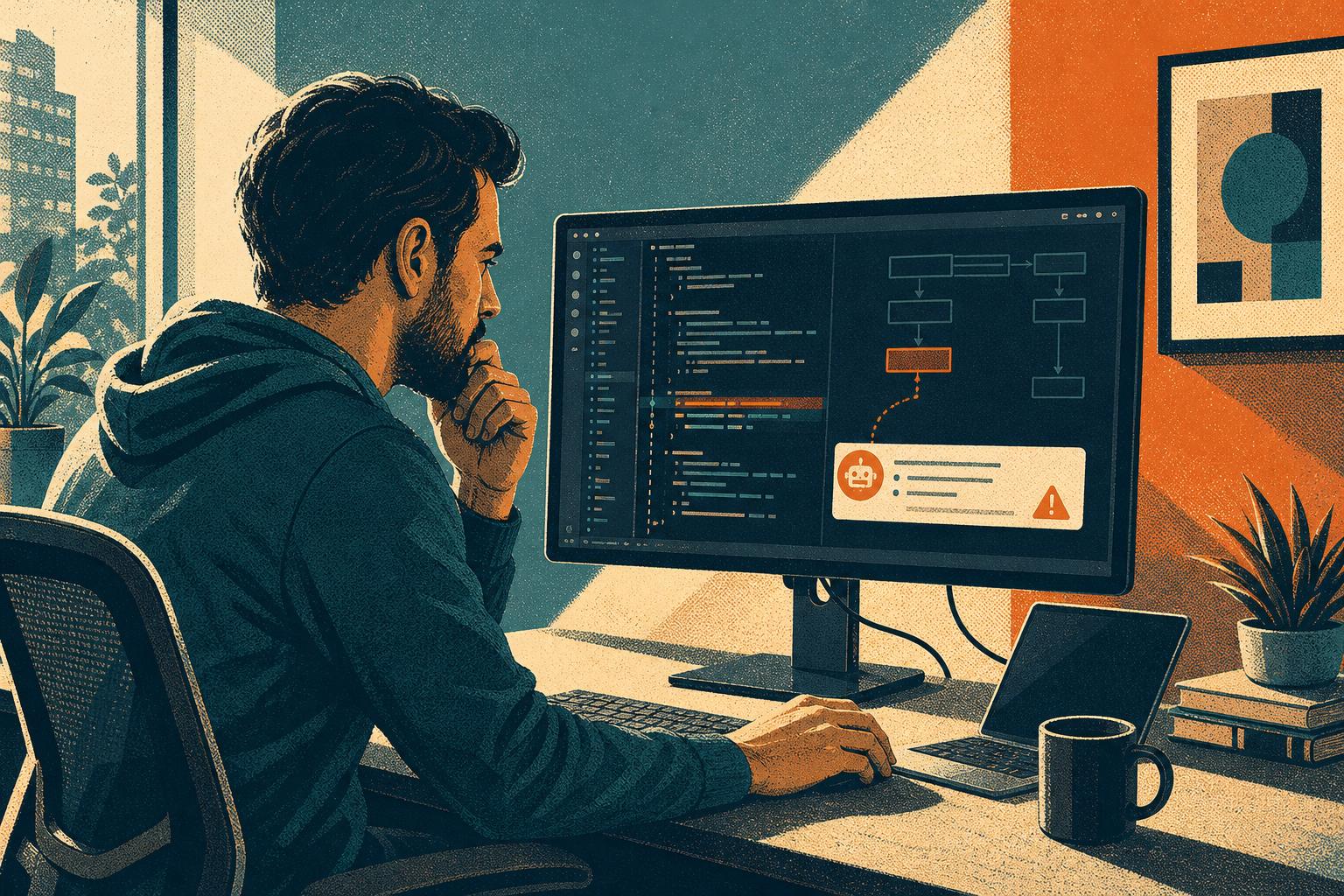
An AI QA agent belongs at two points in your pipeline, not one: inside the IDE before code is committed, and inside CI/CD on every pull request. The IDE stage catches coverage gaps while a developer still has context loaded in their head; the CI/CD stage is where tests actually run against real application behavior and failures get classified before anyone has to look at a log file. Most teams only solve half of this problem, usually leaning on a VS code AI extension for code suggestions while leaving end-to-end verification as a manual, after-the-fact chore. That gap is exactly where a fast-shipping team without a dedicated QA function starts to feel pain.
TL;DR
- An AI QA agent should sit at two checkpoints: the IDE (pre-commit coverage check) and CI/CD (post-PR test execution and triage).
- Code review tools and coding assistants check whether code looks right; a QA agent checks whether the product actually works, by running tests.
- Failure triage (product defect vs. test issue vs. environment issue) needs to happen automatically and fast, or CI/CD pipeline automation just produces more noise for developers to sort through.
- Industry QA-to-developer ratios are shifting from roughly 1:3-1:5 toward 1:8-1:10 as AI-driven automation takes on more of the testing load, but coverage is still the top gap teams report.
- Amikoo places test generation and triage directly in this pipeline, from VS Code through pull-request CI, without requiring teams to adopt a proprietary test runtime.
Why Does Pipeline Placement Matter for an AI QA Agent?
Placement matters because testing value decays the further it sits from the point of code change. A QA agent that only runs once a week in a staging environment is reporting on code that's already three sprints old by the time anyone reads the results. The entire premise of ai test automation is catching regressions close to the moment they're introduced, which means the agent has to live inside the actual flow of work: IDE, pull request, and merge, not a separate testing phase bolted on afterward.
This is also where the buyer profile matters. In most fast-shipping web teams, E2E testing hasn't landed on a QA team at all, it's landed on a developer who already has a full-time job writing features. That developer doesn't have bandwidth to run a manual regression pass before every release. An AI QA agent that's positioned correctly doesn't just make an existing QA team faster, it gives a team with no QA function the coverage they'd otherwise have to hire for.
What Should Happen in VS Code, Before Code Is Even Committed?
Before a pull request exists, the highest-leverage move is surfacing coverage gaps while a developer is still looking at the change. A VS Code AI extension integrated into the QA workflow can flag, in real time, which user flows a new feature touches and whether tests already exist for them. This is fundamentally different from a linter or a coding assistant suggesting syntax, it's asking "does anything verify that this flow still works?"
Practically, this stage should do three things:
- Map the change to user flows. A login redesign or a new dashboard touches specific, identifiable paths through the app, not the whole codebase.
- Surface existing coverage gaps. If a flow has no test, that should be visible before the PR opens, not discovered after a production incident.
- Generate or scaffold tests early. Catching the need for a test at commit time is cheaper than catching it after a failed deploy.
Amikoo's VS Code integration works this way: it generates tests and surfaces coverage gap analysis directly in the editor, so a developer can see a gap before the code is committed rather than after a pipeline run flags it. This is optional, not another step to remember. The core verification still happens automatically on every pull request; the editor is where a developer can check coverage or ask for a test on demand, when they want to.
What's the Difference Between AI Code Review and an AI QA Agent?
Code review tools read diffs; a QA agent runs the application. That distinction gets blurred in marketing copy for ai agents for developers, so it's worth being precise. A code review tool like a linter-plus-LLM setup can flag an unhandled exception, an unused variable, or a logic pattern that looks suspicious. It does this by analyzing the code itself, line by line.
An AI QA agent does something categorically different: it executes the application through a browser, clicks through the actual user flow, and observes whether the real behavior matches expectations. Configuring AI code review as a required status check is a well-established pattern for gating merges on static analysis [augmentcode.com], but static analysis alone can't tell you whether a checkout flow actually completes or a dashboard actually renders its charts. That requires running the software, which is what separates code review from true end-to-end verification.
Think of it like the difference between a building inspector reading blueprints versus someone actually turning on the water and flushing every toilet in the building. Both are useful. Only one tells you the plumbing works.
Where Exactly Does Testing Fit in the CI/CD Pipeline?
Building on the IDE-stage argument above, the CI/CD pipeline is where testing has to become non-negotiable rather than optional. AI agents in modern pipelines tend to cluster around five points: pull request review, test selection and repair, build-failure triage, security remediation, and post-deploy verification [spacelift.io]. An AI QA agent's core job sits squarely in the middle two of those: running and repairing tests, and triaging what broke. Here's a reasonable framing of how responsibilities split across a pipeline using devops testing tools built around an AI QA agent:
| Stage | What Happens | Who/What Owns It |
|---|---|---|
| IDE (pre-commit) | Coverage gap detection, test scaffolding | Developer + AI QA agent (VS Code integration) |
| Pull request opens | Test generation for the specific change, mapped to user flows | AI QA agent |
| CI run | Tests run in Amikoo's cloud, or in the team's existing pipeline as standard Playwright tests | AI QA agent, inside existing CI/CD pipeline automation |
| Failure detected | Diagnose: product defect, test issue, or environment issue | AI QA agent, human (final call on release risk) |
| Confirmed defect | File the issue, notify the team | AI QA agent |
| Merge decision | Accept risk, block merge, or request fix | Human (developer/reviewer) |
CI/CD platforms like GitHub Actions already give teams a YAML-based, webhook-triggered foundation with a large marketplace of integrations, and Azure DevOps adds enterprise governance and multi-stage deployment gates on top of that. An AI QA agent doesn't replace that infrastructure. With Amikoo, teams have two ways to run tests. Because the tests are standard Playwright TypeScript in the team's own repository, they can run in the existing pipeline like any other test suite. Amikoo also offers cloud execution: Amikoo's Auditor checks the repository once, and if anything is missing, Amikoo opens a pull request with the changes. Once that's merged and the check passes, tests run in Amikoo's cloud, started from the Tests list or by asking in plain language, such as 'run all the checkout tests in the cloud.' Each run returns the result, the duration, and a video of the run.
How Should Failure Triage Actually Work?
A related but distinct question from pipeline placement is what happens the moment a test fails. This is where a lot of automated regression testing tools fall short: they report red, and a human has to figure out why. A test failure has exactly three possible root causes, and they require different responses:
- Product defect: the application genuinely broke. This needs to block the merge and get filed as a real issue.
- Test issue: the test itself is stale, maybe a selector changed because of a legitimate UI update. This needs a repair, not a bug report.
- Environment issue: flaky infrastructure, a timeout, a dependency hiccup. This needs a retry, not panic.
An AI QA agent's job is to perform this classification automatically, before any repair happens. Repairing a test without first confirming the failure wasn't a real product bug would mean silently papering over an actual defect. The human role isn't triage at all; it's the final call on release risk, based on the evidence the agent reports.
Amikoo's approach reflects this: the Amikoo agent only fixes a test after the failure has been diagnosed as a test issue rather than a product or environment problem, and confirmed defects get filed as GitHub issues with Slack notifications rather than silently patched over.
Does Adding an AI QA Agent Actually Pay Off?
Stepping back from pipeline mechanics, the practical question every engineering lead asks is whether this is worth the setup cost. Current industry reporting indicates enterprises adopting AI-driven test automation typically see measurable test automation roi within 3 to 6 months, driven by meaningful reductions in manual testing effort and faster release cycles. That timeline tracks with what you'd expect: most of the cost is in the first month of setup and calibration, and most of the savings compound from there as the suite covers more of the product.
The ROI math also shows up in team structure. Industry QA-to-developer ratios have traditionally run 1:3 to 1:5, but AI-driven automation is pushing that toward 1:8 or 1:10. That's not a story about headcount being slashed, it's a story about where engineering spend goes: less toward manually writing and re-writing regression scripts, more toward reviewing evidence and making release decisions. Coverage, not headcount, is still the sticking point: roughly 35% of QA teams cite increasing coverage as their top priority, which lines up with why pipeline placement (catching gaps at commit time, not after a release) matters more than raw test count.
On a technical note specific to Amikoo: internal benchmarking specific to Amikoo's architecture comparing the Amikoo agent's test generation and repair against general-purpose coding agents (Claude, Codex) showed directionally lower token usage and faster completion for the same tasks, and internal benchmarking comparing the Amikoo agent against Playwright's native test healer showed a higher repair success rate and fewer iterations per fix. These internal benchmarks are not independently verified and should be read as directional rather than universal.
Frequently Asked Questions
What's the best place to start if my team has no AI QA agent at all?
Start at the pull request. Connecting your repository so every PR is verified automatically gives the most coverage for the least effort, and takes about 30 minutes to set up. IDE-level visibility is a useful addition once that's running.
Is an AI QA agent the same as a code review tool?
No. Code review tools analyze diffs and flag code-level issues. An AI QA agent executes the application and verifies real behavior through running tests, which is a different and complementary layer.
What are the best ai testing tools for Playwright-based teams?
Playwright itself has become the dominant end-to-end framework, with a 45.1% adoption rate among QA professionals according to recent industry surveys and continued momentum in npm downloads. Tools built to generate, run, and maintain Playwright tests natively, rather than introducing a separate proprietary format, tend to fit more cleanly into existing pipelines.
Can an AI QA agent replace a QA team entirely?
For teams with no dedicated QA function today, an AI QA agent can cover much of the generation, execution, and failure-diagnosis work. Teams with an existing QA function typically use it to extend coverage and reduce manual maintenance rather than replace the function outright.
Does using an AI QA agent mean switching to a new testing framework?
Not necessarily. Agents that generate standard Playwright TypeScript code committed to your own repository avoid proprietary lock-in, meaning the tests keep running even if you change tooling later.
How does this fit with GitHub Actions or Azure DevOps pipelines already in place?
Either way works. Amikoo's tests are standard Playwright TypeScript in your repository, so they can run in your existing GitHub Actions or Azure DevOps pipeline. Teams that don't want to manage that can use Amikoo's cloud execution instead: after a one-time repository check, tests run in Amikoo's cloud and return the result, duration, and a video of each run.
What does "self-healing" actually mean in this context?
It means a test is automatically repaired once a failure has been diagnosed as a test issue, not a product defect. Repair without diagnosis risks masking a real bug, so diagnosis has to come first.
About Amikoo
Amikoo is an AI agent by MuukLabs that owns end-to-end verification for web applications. Developers connect their app and repository in about 30 minutes. From then on, on every pull request, Amikoo understands the change, determines which user flows need verification, creates or updates standard Playwright TypeScript tests in the team's own repository, runs them, diagnoses each failure as a product defect, test issue, or environment issue, and reports real defects. It's built for fast-shipping teams, often using coding agents like Claude Code or Cursor, where E2E testing has fallen on developers and the current workflow can't keep up. Amikoo complements coding agents rather than replacing them: AI writes and reviews the code, Amikoo verifies the product actually works. It connects to GitHub and Azure DevOps, with Bitbucket and GitLab support in progress, with no proprietary runtime or lock-in. MuukLabs also offers MuukTest, an expert-backed services brand under the same parent company, for teams that want hands-on QA support alongside the platform.
If your pipeline currently stops testing at code review and picks back up with a human manually clicking through flows before release, that's the exact gap an AI QA agent is meant to close. Visit https\://amikoo.ai/ to see how Amikoo fits into your VS Code and CI/CD workflow.
References
- Where Do AI Agents Fit in CI/CD Pipelines? (spacelift.io)
- How to Set Up AI Code Review in Your CI/CD Pipeline | Augment Code (augmentcode.com)