
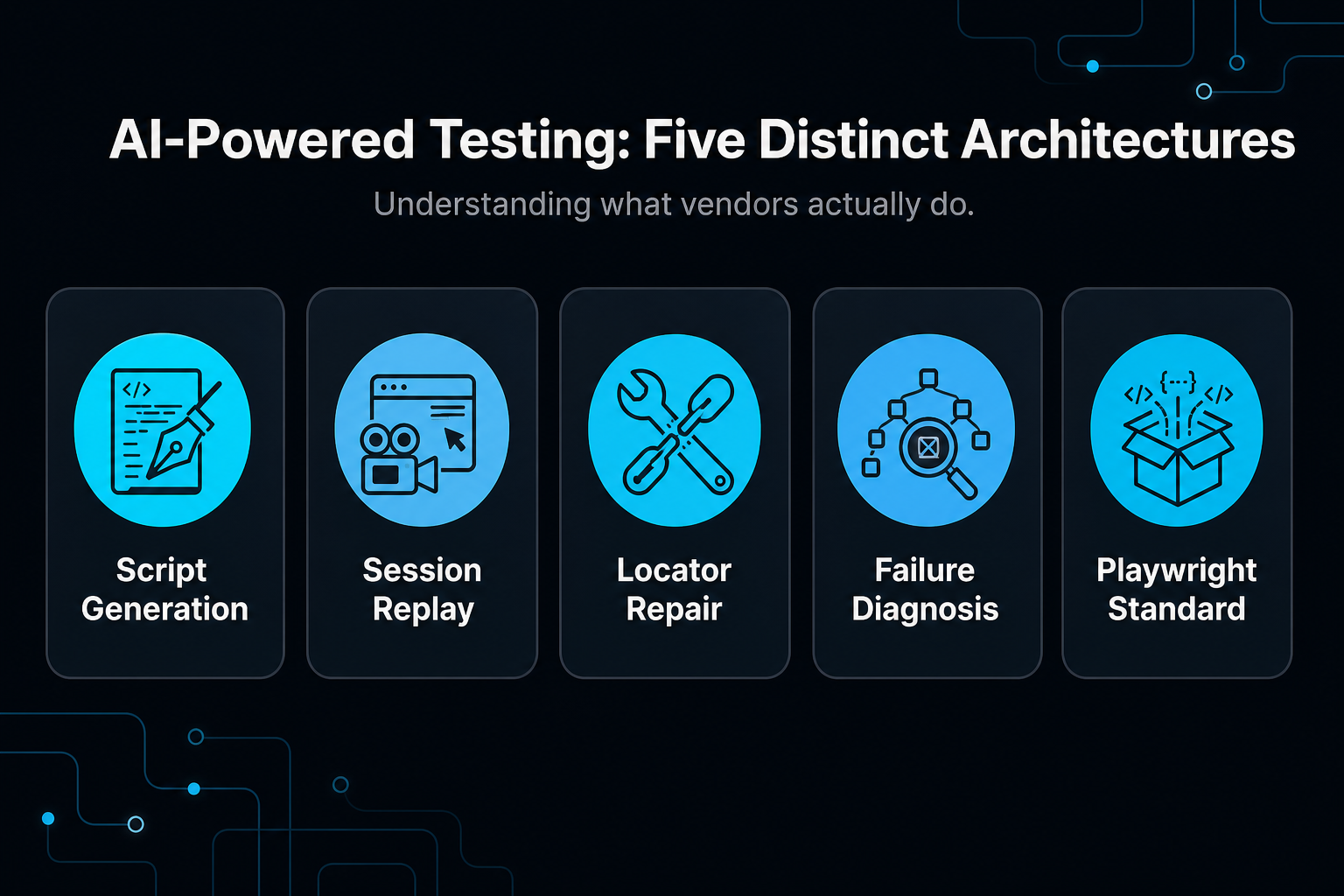
"AI-powered testing" is a marketing phrase, not a technical spec, and that's exactly why it causes so much buyer confusion in 2026. The term covers at least five genuinely different architectures: tools that use AI to write test scripts, tools that use AI to replay recorded sessions, tools that use AI to repair broken locators, tools that use AI to analyze failures, and tools that combine several of these. Before you evaluate any vendor, you need to know which of these your product actually does, because the gap between "AI picked the test case" and "AI diagnosed why a test failed and fixed only what should be fixed" determines whether the tool saves you time or quietly creates new problems.
TL;DR
- "AI-powered testing" has no single definition; it can mean AI-generated scripts, AI-driven session replay, self-healing locators, AI failure triage, or some combination.
- Self-healing test automation specifically refers to systems that detect UI-driven locator breakage and update element references or steps without a human rewriting the test.
- Not every failure is a broken locator; some are real product defects, and conflating the two is how teams end up shipping bugs that "self-healed" past their tests.
- Playwright has become the reference framework many AI-powered tools generate against, which matters when you're comparing Playwright vs Selenium-era approaches.
- Test automation ROI depends less on how many tests get written and more on how much engineer time goes into maintaining and interpreting them.
What Does "AI-Powered Testing" Actually Mean?
At its broadest, AI-powered testing means using machine learning or large language models somewhere in the test lifecycle: generation, execution, maintenance, or analysis. That breadth is the problem. A tool that uses AI only to suggest which existing manual tests to run first and a tool that uses AI to write, execute, diagnose, and repair entire test suites both get marketed under the identical phrase. Industry coverage of the category increasingly treats it as a set of distinct capability types rather than one unified technology, and claims about reducing breakage deserve scrutiny on a case-by-case basis. The practical takeaway: ask any vendor exactly which part of the pipeline their AI touches, and ask what happens at every other part.
What Is the Difference Between Scripted Automation and AI Test Automation?
Scripted automation means a human writes explicit step-by-step instructions (click this selector, assert that text) that execute identically every run. AI test automation introduces a layer that can generate those steps from a goal or a recorded flow, adapt selectors when the DOM changes, or interpret an outcome rather than just checking a hardcoded condition. The distinction matters because scripted suites are precise but brittle: a renamed class or restructured component can break hundreds of hardcoded locators overnight. AI test automation tools are built specifically to absorb that kind of churn, though the degree to which they do so correctly, rather than papering over a real bug, varies enormously by product [testmuai.com][testgrid.io]. This is the fork in the road: some platforms optimize purely for "keep the suite green," while others optimize for "tell me the truth about what broke."
What Is Self-Healing Test Automation, and What Are Its Limits?
Self-healing test automation is an approach where automated tests use AI and machine learning to detect failures caused by interface changes, then automatically update element locators or test steps to keep the tests running, without a person manually rewriting them. That's a precise, widely-used industry definition, and it's worth holding vendors to it rather than accepting the looser marketing version.
The limit most buyer guides underplay: self-healing can only responsibly fix the test if the underlying product behavior is actually still correct. If a button moved because of a redesign, updating the locator is the right call. If a button stopped working because of a regression, "healing" the test to pass anyway hides a real defect. This is why Amikoo's Repair Agent is built to diagnose before it repairs: it determines whether a failure is a product defect, a test issue, or an environment issue first, and only proceeds to fix the test when the issue is genuinely a test issue, not a symptom of broken product behavior. In internal benchmark testing against Playwright's native Healer Agent, Amikoo's Repair Agent resolved failures at roughly twice the success rate (70% vs. 34%), completed repairs about five times faster (around 5 minutes vs. 25 minutes per cycle), and used about 28% fewer tokens, with fewer iterations needed per test. These figures are internal and benchmark-specific, not independently verified, but they illustrate the kind of diagnose-then-repair discipline worth asking any self-healing vendor to demonstrate.
How Does Playwright Compare to Selenium for AI-Driven Testing?
Playwright, the Microsoft-developed framework, provides a single API for cross-browser testing across Chromium, Firefox, and WebKit, with built-in auto-waiting, web-first assertions, and parallel execution baked in. Recent releases have added features aimed at AI-driven workflows, reflecting how actively the framework is being adapted for AI-generated tests. Selenium, the older standard, requires more manual handling of waits and timing, which is precisely the kind of brittle setup that makes locator drift and flaky failures more common.
This is why most of the current generation of AI-powered testing tools, Amikoo included, target Playwright as the output format rather than inventing a proprietary scripting language. Standard Playwright TypeScript code committed to your own repository means the tests keep running in your CI/CD pipeline even if you ever stop using the AI layer that generated them. That portability is a meaningfully different bet than tools that lock your test logic into a proprietary runtime or YAML format you can't take with you.
How Should You Evaluate AI QA Tools Against Each Other?
Evaluating AI QA tools starts with mapping each one to a category, not a feature list, because the categories solve different problems. The table below groups current platforms by their core mechanism, based on verified public descriptions of each.
| Tool | Core Mechanism | Notable Characteristic |
|---|---|---|
| QA Wolf | Managed service, AI generates/runs/maintains Playwright tests | Cloud infrastructure; fully managed rather than self-hosted |
| Momentic | Natural-language authoring with intent-based locators | YAML stored locally, but requires cloud connection for AI locator cache |
| Checksum | AI agents generate and self-heal Playwright tests | Delivers working Playwright tests; priced per workflow maintained |
| Meticulous | Session replay of recorded real user flows | No manual test authoring at all; deterministic browser, mocked network |
| Amikoo | Generates, runs, diagnoses, and repairs Playwright tests per pull request with Workers | Tests committed as standard code in your own repo; no proprietary runtime |
Notice the architectural split: some tools, like Momentic, depend on a cloud connection even for tasks that look local. Others (Meticulous) trade all manual authoring for pure session replay, which is powerful for regression coverage but means you can't hand-direct what gets tested. Amikoo’s distinction is diagnosis before repair: it determines whether a failure is a product defect, a test issue, or an environment issue before changing anything, and teams decide what it does and when automatically through Workers. If you're searching for a CodeRabbit alternative that goes beyond diff-level code review into actually running the application, the category you want is end-to-end verification tools, not code review tools, since code review checks whether code looks right, not whether the product behaves right.
Why Does Automated Regression Testing Still Fail on Fast-Shipping Teams?
Automated regression testing fails most often not because the tests are badly written, but because nobody has time to maintain them as the product changes underneath them. This is the exact bottleneck on fast-shipping teams without QA: a developer who inherited E2E testing because there's no dedicated QA function, and who is now watching a backlog of flaky, outdated tests grow every sprint while also shipping features.
Amikoo is built for exactly that handoff. Developers connect their repository, then set up Workers that tell Amikoo what to do and when, like writing the missing Playwright tests whenever a pull request opens, after determining which user flows need verification. Tests run in your own CI/CD pipeline or in Amikoo's cloud, started from the Tests list or by asking in the Amikoo chat, with each cloud run returning the result, duration, and a video. Amikoo diagnoses any failure as a product defect, test issue, or environment issue, repairs test issues, and files real defects straight into your tracker. You make the final call on release risk; the testing work is off your plate.
What Does Real Test Automation ROI Look Like?
Test automation ROI should be measured in engineer hours reclaimed from test maintenance, not in raw test count. A suite with 2,000 tests that nobody trusts because a third of them are flaky delivers negative ROI: it costs CI minutes and erodes confidence every time someone has to manually decide whether a red build means a real bug or a known flaky test. A smaller suite that reliably distinguishes real defects from noise, and repairs itself correctly when the product legitimately changes, delivers compounding ROI because engineers stop budgeting time to babysit it.
This is also where the budget conversation is shifting industry-wide: rather than framing AI test tools as headcount replacement, most engineering leaders are reframing the spend, moving dollars from manual scripting labor toward quality engineering oversight, where a smaller number of people review evidence and set policy rather than writing and re-writing scripts by hand.
Frequently Asked Questions
Is AI-powered testing the same as self-healing tests?
No. Self-healing is one specific capability (automatically updating broken locators or steps) within the broader AI-powered testing category, which also includes generation, execution, and analysis.
Does AI test automation replace manual QA entirely?
Not for the decision-making part. AI tools can generate, run, diagnose, and repair tests at scale, but a human still decides what level of risk is acceptable to ship based on the evidence reported.
Is Playwright better than Selenium for AI-generated tests?
Playwright's built-in auto-waiting, web-first assertions, and single cross-browser API make it a more stable target for AI-generated test code than Selenium's more manual timing model, which is part of why most current AI testing platforms output Playwright.
What's the risk of self-healing tests specifically?
The core risk is a tool "healing" a test to pass when the underlying behavior is actually broken, masking a real defect. Diagnosing the failure type before repairing is the safeguard against that.
How is Amikoo different from a code review tool?
Code review tools analyze whether code looks correct; Amikoo runs the actual application through generated Playwright tests to verify it behaves correctly, which is a different and complementary layer of assurance.
Does adopting an AI QA tool require migrating off existing tests?
Not necessarily. Amikoo supports migrating existing Cypress or Selenium suites to Playwright, and since output is standard Playwright TypeScript in your own repo, there's no proprietary format lock-in.
About Amikoo
Amikoo is an AI QA agent by MuukLabs that owns end-to-end verification for web applications. Developers connect their app and repository in about 30 minutes. From then on, on every pull request, Amikoo understands the change, determines which user flows need verification, creates or updates standard Playwright TypeScript tests in the team's own repository, runs them, diagnoses each failure as a product defect, test issue, or environment issue, and reports real defects. It's built for fast-shipping teams, often using coding agents like Claude Code or Cursor, where E2E testing has fallen on developers and the current workflow can't keep up. Amikoo complements coding agents rather than replacing them: AI writes and reviews the code, Amikoo verifies the product actually works. It connects to GitHub and Azure DevOps, with Bitbucket and GitLab support in progress, with no proprietary runtime or lock-in. MuukLabs also offers MuukTest, an expert-backed services brand under the same parent company, for teams that want hands-on QA support alongside the platform.
If your team is trying to figure out which flavor of "AI-powered testing" actually fits a fast-shipping workflow, take a look at Amikoo and see how diagnosis-first repair and pull-request-triggered verification work in practice.
References
- AI Testing: What It Is, Types, Strategy and Platform (testmuai.com)
- AI Testing: What It Is, What It Isn't, and Why It Matters (testgrid.io)