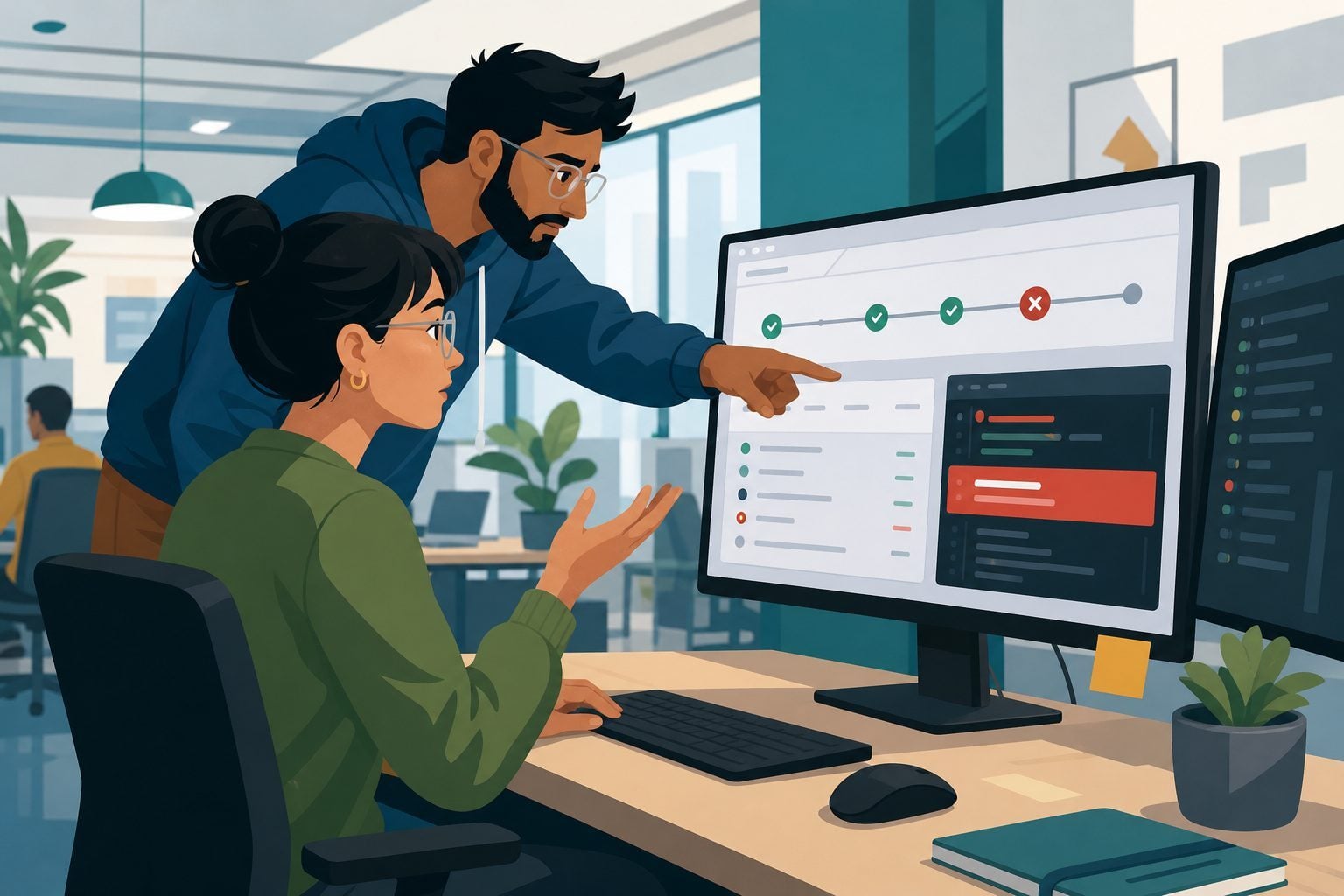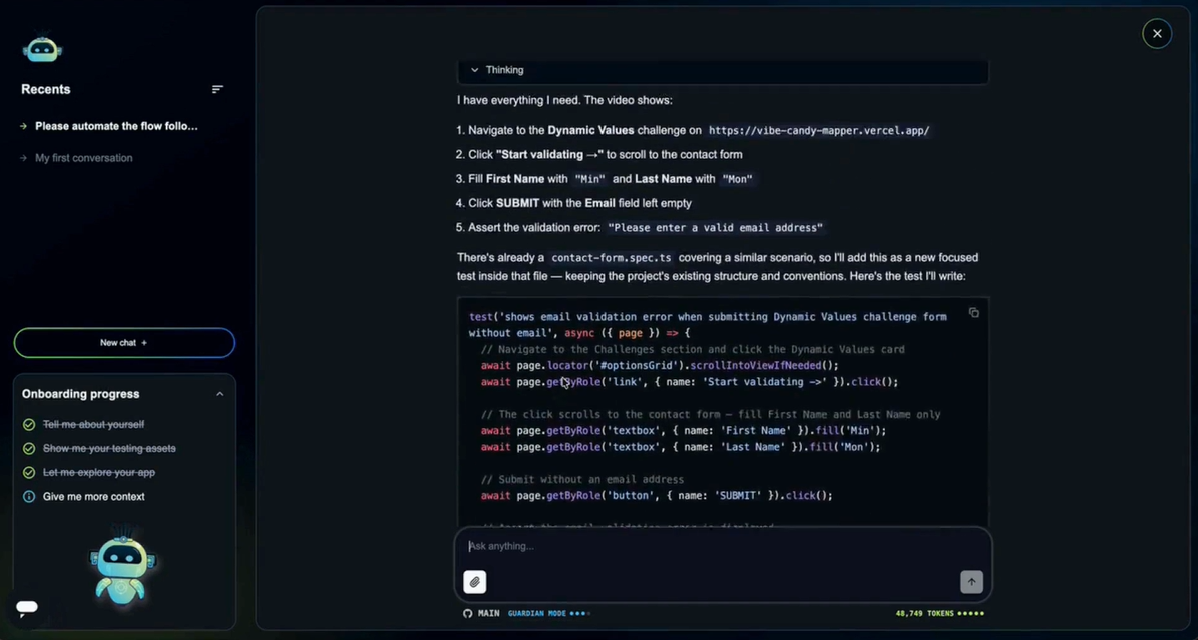
Untested surface area is the portion of a live product, every user flow, edge case, and integration path, that has shipped to production without an automated test ever running against it. Most engineering teams can tell you their unit test coverage percentage. Almost none can tell you what percentage of their actual user flows have end-to-end verification, because that number requires mapping the product as users experience it, not just the code as developers wrote it. Amikoo was built specifically to answer that question: it maps critical user flows against what is actually tested and surfaces the gaps, which is why this topic sits at the center of what the product does rather than at the edge of it.
TL;DR
- Code coverage percentages measure lines executed, not user flows verified. A codebase can show 80% coverage and still have major features with zero end-to-end checks.
- Untested surface area accumulates fastest in teams shipping quickly with AI coding tools, where code gets written faster than anyone can manually test it.
- A proper test coverage report maps flows (login, checkout, settings changes) against what automated tests actually exercise, then ranks gaps by business criticality.
- Migrating from Selenium or Cypress to Playwright is a common moment to audit coverage, since teams often discover the old suite tested far less than assumed.
- Closing coverage gaps on already-shipped code is a different problem than testing new pull requests, and most tooling only solves the second one.
Amikoo is built by MuukLabs around roughly six years of accumulated QA practice, applied specifically to the problem of mapping and closing coverage gaps on products that have already shipped. That focus, on retroactive coverage rather than only new-code testing, is what grounds the analysis in this article.
What Counts as "Untested Surface Area" in a Shipped Product?
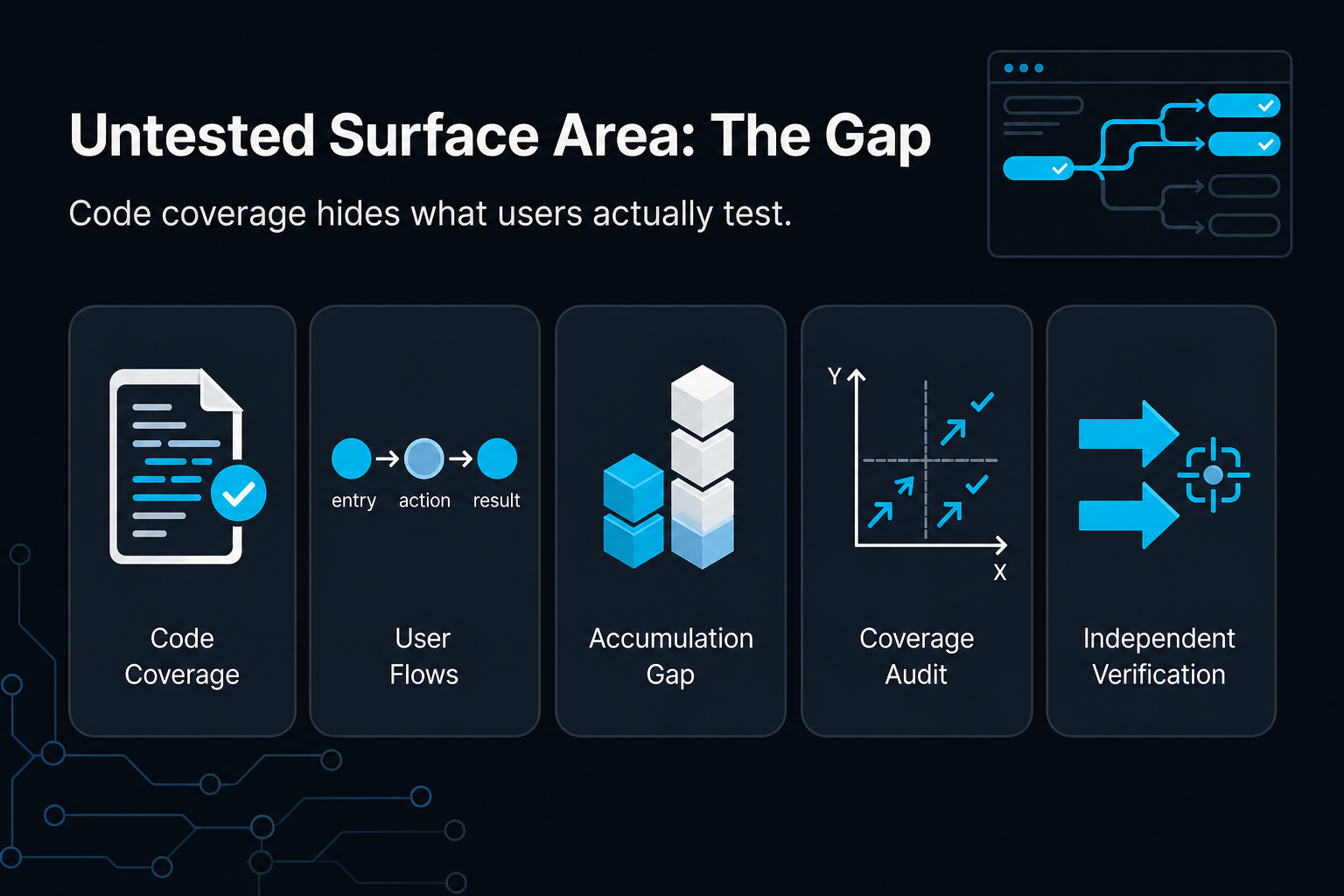
Untested surface area is any user-reachable path through your application that no automated test currently exercises end to end. This is a different measurement than code coverage. A unit test can execute a function and register as "covered" while never confirming that a real user can complete the flow that function supports. A checkout page might have 90% of its component code covered by unit tests while the actual multi-step purchase flow, selecting a plan, applying a coupon, submitting payment, has never been run start to finish by a machine.
The practical way to find untested surface area is to map your product by user flow rather than by file. List the flows a real user takes: sign up, reset password, upgrade a subscription, invite a teammate, export a report. For each flow, ask whether an automated test runs it today, and whether that test would actually catch a regression if the flow broke. Flows with no answer, or a weak one, are your untested surface. Amikoo does this mapping for you and keeps it current. Teams can get a weekly coverage report with their top priorities and see coverage gaps directly in VS Code, which matters because the map changes every time a new feature ships.
Why Does Code Coverage Percentage Hide the Real Gap?
Building on the distinction above, a code coverage tool answers "which lines ran during testing," which is a narrower question than "which user flows work." Coverage tools like Istanbul or Jest's built-in reporters are genuinely useful for catching dead code and untested branches, but they were never designed to answer whether a feature behaves correctly from a user's perspective.
Here is the mechanism: a line of code can execute successfully inside a unit test with mocked dependencies, registering full coverage, while the same line fails in production because a real API returned an unexpected shape, a third-party script blocked rendering, or a race condition only appears under network latency. Unit tests isolate code from its environment on purpose; that isolation is exactly what makes them fast, and exactly what makes them blind to integration failures. End-to-end tests, by contrast, run the application the way a browser actually would, which is why automated regression testing built on true end-to-end execution catches a different class of bug than coverage percentages ever will.
A useful analogy: code coverage is like checking that every light switch in a building has power running to it. That tells you the wiring exists. It does not tell you whether the light actually turns on when someone flips the switch, whether the bulb is in, or whether the switch is wired to the room it's labeled for. End-to-end verification is flipping the switch and watching the room.
How Does Untested Surface Area Accumulate Over Time?
Given that coverage percentages can mask real gaps, the next question is how those gaps grow. Untested surface area compounds in a specific, predictable way: new features get shipped with partial or no end-to-end tests because writing them is slow, and the backlog of untested flows grows faster than any manual QA process can close it. Teams using AI coding assistants like Claude or Codex to write application code often ship even faster, which widens the gap further unless test generation keeps pace. This is the central failure mode for fast-shipping teams without a dedicated SDET or QA function: a developer is handed end-to-end testing as a side responsibility, falls behind within a few sprints, and the untested surface quietly becomes most of the product. Nobody decided to skip testing checkout edge cases or the admin settings panel; it simply never got prioritized against shipping the next feature. A software defect tracking tool will eventually surface the bugs this produces, but by then they are production incidents, not caught-in-review issues.
How Do You Actually Measure and Report on Coverage Gaps?
Turning the accumulation problem into something actionable requires a different kind of test coverage report, one organized by flow and risk rather than by file. The structure that works looks like this:
| Dimension | What it answers | Example |
|---|---|---|
| Flow coverage | Is this user flow tested end to end? | "Password reset: no test" vs. "Checkout: tested, 3 edge cases missing" |
| Business criticality | How much does a failure here cost? | Payment flow failures block revenue; a cosmetic settings bug does not |
| Change frequency | How often does this area get modified? | Code that changes weekly needs tests more than code untouched in a year |
| Failure classification | When a test fails, why? | Product defect, test issue, or environment error |
This is where Amikoo's coverage mapping differs from a static dashboard: it stays current as the codebase changes, rather than being produced once during a quarterly audit. Teams set up Workers that tell Amikoo what to do and when. With a pull request Worker, when a PR opens, Amikoo reviews the change, determines which flows it affects, and writes the missing tests into the PR. A scheduled Worker can also email a weekly coverage report that flags previously shipped flows that were never covered in the first place, which is the harder and more neglected half of the coverage problem. Tests run in the team's pipeline or in Amikoo's cloud, started from the Tests list or by asking in the Amikoo chat, with each cloud run returning the result, duration, and a video.
Does Migrating from Selenium or Cypress to Playwright Change Your Coverage Picture?
Stepping back from measurement into tooling, a migration is often the moment teams first discover how much of their product was never actually tested. When teams compare Playwright vs Selenium or Playwright vs Cypress, the conversation usually centers on speed, flakiness, and language support. Playwright is an open-source framework built by Microsoft that automates Chromium, Firefox, and WebKit through a single API, with auto-waiting, parallel execution, and network interception built in, which generally makes it faster to write and more stable to run than older Selenium-based suites.
But the more revealing discovery during a Selenium to Playwright migration is usually coverage, not speed. Old Selenium suites accumulated over years often turn out to test a narrow, outdated slice of the product, because nobody re-audited them as the application grew. Migrating gives teams a natural checkpoint to ask "what should this suite actually cover" rather than mechanically porting old tests one for one. Amikoo fits this moment well: instead of translating old test syntax into new, it maps the product's current flows and generates new Playwright coverage for them alongside the existing suite, so the old one can be retired once the gaps are closed.
What's the Right Human and AI Split for Closing These Gaps?
None of this mapping and reporting removes the need for a judgment call on release safety. Amikoo performs the testing work end to end: it determines which flows need verification on a given change, generates or updates the Playwright TypeScript tests, runs them, diagnoses any failure as a product defect, a test issue, or an environment issue, repairs test issues, and reports confirmed defects. People review that evidence and decide whether a release is safe to ship.
That division matters because AI-powered testing that is independent of the AI that wrote the application code closes a specific risk: a coding assistant cannot quietly pass its own broken tests if the verification layer was never written by that assistant in the first place. Amikoo's Repair Agent reinforces this by diagnosing failures before attempting any fix, distinguishing a genuine product regression from a test that simply needs updating because the UI changed, so repairs never paper over a real defect. Only test issues get repaired; real defects get filed straight into the team's tracker, like GitHub issues or Jira. In internal benchmarks against Playwright's native Healer Agent, the Repair Agent achieved 2x the repair success rate (70% vs. 34%) and 5x faster repair cycles while using 28% fewer tokens. These are internal, benchmark-specific results, not independently verified.
Frequently Asked Questions
What is the difference between code coverage and test coverage?
Code coverage measures which lines of code executed during testing. Test coverage, in the flow-based sense used here, measures which user flows have been verified end to end. A codebase can have high code coverage and low test coverage simultaneously.
How do I find untested surface area in an existing product?
Map your product by user flow rather than by file, then check which flows have an automated end-to-end test that would catch a regression. Amikoo can automate this mapping continuously as the product changes.
Is Playwright better than Selenium for regression testing?
Playwright generally offers faster execution, built-in auto-waiting, and native multi-browser support through one API, which tends to reduce flakiness compared to older Selenium-based suites, though the right choice depends on existing infrastructure and team familiarity.
Can AI-generated tests be trusted if AI also wrote the application code?
It is safer when test generation is handled by a separate system than the one writing application code, since a single AI validating its own output risks passing broken code. Amikoo's verification runs independently of whichever coding assistant produced the change.
How often should a test coverage report be regenerated?
Coverage changes with every pull request, so a quarterly report is outdated by the time anyone reads it. Amikoo writes missing tests as pull requests open, through a Worker, and can send a daily or weekly coverage report so gaps in older flows stay visible too.
Does Amikoo replace manual QA entirely?
No. Amikoo handles test generation, execution, repairs test issues, failure diagnosis, and defect reporting; people review that evidence and decide release risk. MuukTest, a separate services brand under MuukLabs, is available for teams that also want hands-on QA support.
About Amikoo
Amikoo is an AI QA agent by MuukLabs that owns end-to-end verification for web applications. Developers connect their app and repository in about 30 minutes. From then on, on every pull request, Amikoo understands the change, determines which user flows need verification, creates or updates standard Playwright TypeScript tests in the team's own repository, runs them, diagnoses each failure as a product defect, test issue, or environment issue, and reports real defects. It's built for fast-shipping teams, often using coding agents like Claude Code or Cursor, where E2E testing has fallen on developers and the current workflow can't keep up. Amikoo complements coding agents rather than replacing them: AI writes and reviews the code, Amikoo verifies the product actually works. It connects to GitHub and Azure DevOps, with Bitbucket and GitLab support in progress, with no proprietary runtime or lock-in. MuukLabs also offers MuukTest, an expert-backed services brand under the same parent company, for teams that want hands-on QA support alongside the platform.
If your team can't answer how much of your product has never been verified, that's worth fixing before the next release. Visit Amikoo to see how coverage mapping and automated end-to-end testing work together on your own codebase.