
When an AI QA agent flags a test failure it cannot reproduce on a second run, the correct response is not to rerun the test until it passes. It's to treat the non-reproduction itself as data: the failure pattern (intermittent, timing-sensitive, dependency-linked) tells you whether you're looking at environment flakiness, a genuine product defect that only surfaces under specific conditions, or a test script issue. Amikoo was built around exactly this diagnostic step. Before any test gets repaired, Amikoo's Repair Agent classifies the failure as a product defect, a test issue, or an environment issue, because masking a real bug as a test issue defeats the purpose of automated testing.
TL;DR
- A failure an AI agent can't reproduce usually traces to environment flakiness (network latency, configuration drift, external dependencies) rather than application code.
- Test flakiness in CI pipelines is a widespread problem affecting most teams, making this a recurring operational concern, not an edge case.
- Amikoo's Repair Agent diagnoses each failure as a product defect, test issue, or environment issue before touching any code, so repairs don't paper over real bugs.
- Fixing flakiness at the source means standardizing environments with environment-as-code practices and isolating test dependencies, not just adding retries.
- Internal benchmarks show Amikoo's Repair Agent reaching a 70% repair success rate versus 34% for Playwright's native Healer Agent, in 5 minutes versus 25 minutes per cycle; these are internal, benchmark-specific figures, not independently verified.
About this article: Amikoo is built by MuukLabs around a specific problem: on fast-shipping web teams, end-to-end testing usually lands on a developer who has no dedicated QA function and no time to chase down why a test failed once and never again. Amikoo's diagnostic approach to flaky failures comes directly from building test generation and repair systems that run against real pull requests, not synthetic demos.
Why Can't an AI QA Agent Always Reproduce a Test Failure?
A test failure that won't reproduce almost always means the failure condition was transient, not structural. Environment-based test failures stem from external dependencies, configuration drift, or network latency rather than actual code defects, and this class of failure can mask genuine application bugs if a team isn't careful about how it responds. A test that times out waiting on a third-party API, hits a staging database mid-migration, or runs against a browser version that silently updated overnight will fail once and pass the next ten times, with nothing in the application code having changed at all.
This is the core challenge with non-deterministic failures: the absence of a repeatable failure doesn't mean the absence of a problem. It means the problem exists somewhere other than the test assertion itself. An AI agent (or a human engineer) that just reruns the test and moves on when it passes is treating the symptom, not the cause. Over time, that habit trains a team to distrust its own test suite, which is worse than having no tests at all, because now failures get ignored by default.
How Do You Tell Environment Flakiness Apart from a Real Defect?
Distinguishing the two requires looking at what actually changed, not just whether the test passed on retry. Application-based failures indicate real defects in the software's logic, user interface, or backend integration, and they should reproduce consistently given the same inputs and the same environment. Environment issues, by contrast, correlate with something outside the application: a dependency version, a network condition, a timing window.
A practical way to separate the two:
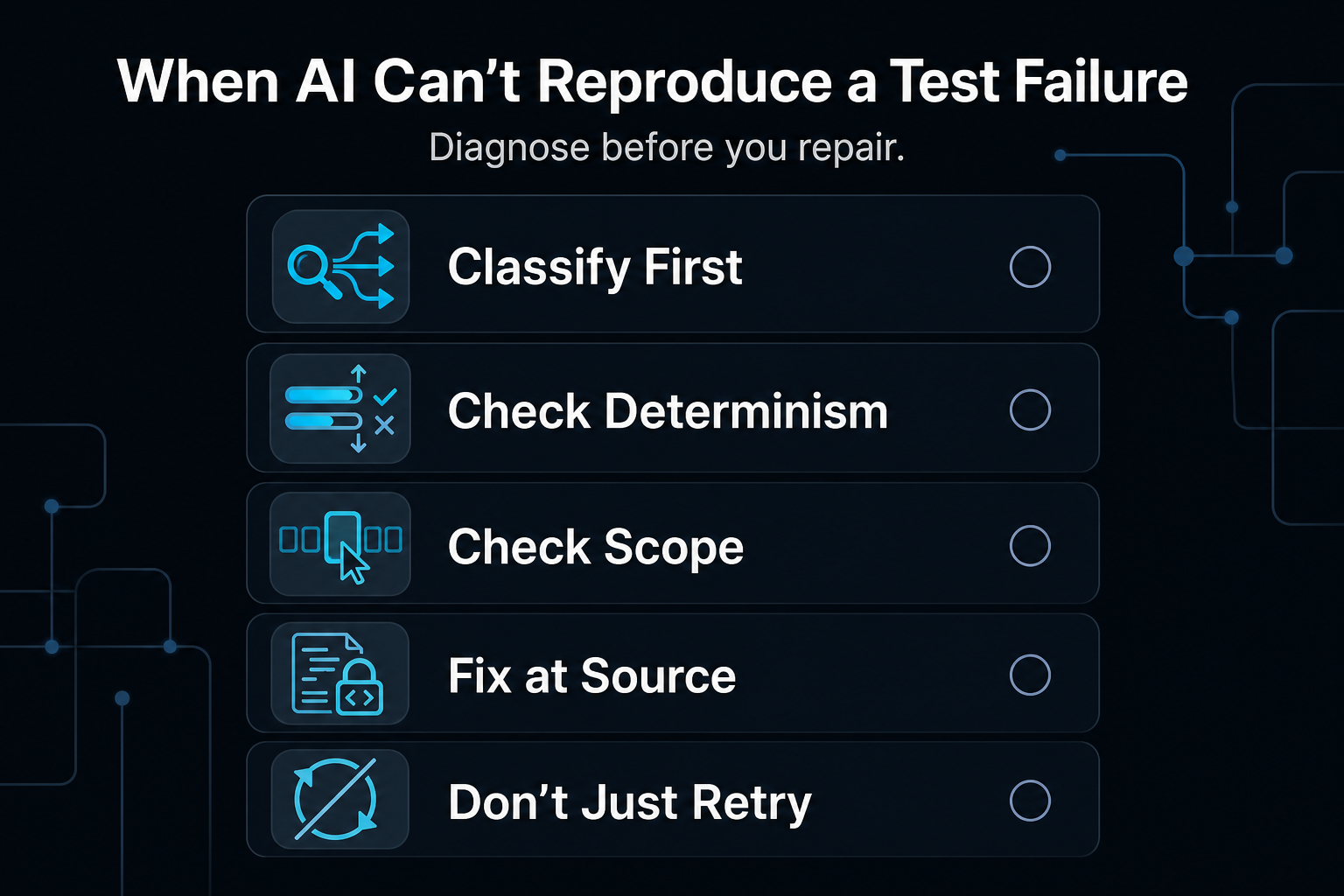
- Check determinism: Does the failure happen on every run with identical inputs, or only intermittently? Consistent failure points to a defect; intermittent failure points to environment or timing.
- Check scope: Does the failure only occur in one environment (staging, a specific CI runner, a particular browser) or everywhere? Scoped failures are usually environmental.
- Check correlation with external systems: Did a third-party API, database, or network call fail or slow down at the same timestamp? That's a strong environment signal.
- Check the diff: Did the application code or UI actually change in the pull request under test? If not, and the failure is new, it's unlikely to be a product defect.
Amikoo performs this diagnosis as a standard part of its workflow. When a test fails, Amikoo doesn't jump straight to patching the test script. It first classifies the failure as a product defect, a test issue, or an environment issue, and only confirmed product defects get filed as real issues, straight into the team's tracker, like GitHub issues or Jira, with the evidence from the run attached.. This matters because automated defect detection is only useful if it's accurate. A system that flags every flaky network blip as a bug trains developers to ignore its alerts within a week.
What's the Right Way to Fix Flakiness at the Source Instead of Patching Around It?
Fixing flakiness at the source means changing the conditions that produce non-determinism, not adding more retries on top of them. Retries and quarantine lists treat the symptom. Mitigating environment-based limitations properly requires standardizing configurations using environment-as-code principles and isolating test dependencies, so the same test behaves the same way no matter which machine, container, or CI runner it executes on.
In practice, that looks like:
- Environment-as-code: Define test environments (browser versions, container images, environment variables) in version-controlled config rather than letting them drift across machines.
- Dependency isolation: Mock or stub external services that aren't the subject of the test, so a third-party outage doesn't fail your checkout flow test.
- Network interception: Playwright's native network interception lets tests control exactly what responses the application receives, removing a major source of timing-based flakiness.
- Statistical tracking over binary pass/fail: Industry-standard approaches increasingly favor tracking retry patterns and confidence intervals rather than treating a single pass or fail as ground truth. Teams increasingly use test analytics to parse execution logs over many runs and isolate root causes of intermittent failures, rather than guessing from a single run.
An analogy that makes this concrete: think of a flaky test like a car that won't start on cold mornings. Jump-starting it every time gets you to work, but it doesn't fix the battery. Environment-as-code is the equivalent of actually replacing the battery: you're addressing the physical condition that causes the symptom, not reacting to the symptom each time it appears.
How Does Playwright's Design Help (and Where Does It Fall Short) on Flakiness?
Playwright's own architecture reduces several common sources of flakiness, which is part of why so many teams choose Playwright for timing-sensitive flows. Its auto-waiting mechanism checks that an element is actionable before interacting with it, and its web-first assertions retry automatically until a condition is met or a timeout expires, instead of asserting against a single snapshot in time. Native parallel execution and cross-browser support for Chromium, Firefox, and WebKit round out a framework designed with flakiness reduction in mind. Playwright has seen rapid adoption growth among teams building E2E test suites, though exact market share figures vary by source and survey methodology.
None of this eliminates environment flakiness, though, because Playwright's waiting and retry logic operates inside the test run. It can't fix a slow upstream API, a misconfigured staging database, or a CI runner with a different locale setting than production. That's an environment problem, and it needs an environment-level fix, or a diagnostic layer that distinguishes "the app is actually broken" from "the test ran into bad luck this time." This is precisely the gap Amikoo's diagnosis step is designed to close, and it's distinct from the generation and repair work Amikoo also does.
What Does This Mean for Tool Choice and Defect Accuracy?
Flaky tests are a direct cost to any testing operation: every minute spent manually investigating a failure that turns out to be a network blip is a minute not spent reviewing real defects. Test flakiness in CI pipelines is a recurring operational concern affecting most teams. When evaluating test automation tooling, pay attention not just to how fast a tool generates tests, but how well it handles the inevitable moment when a test fails and nobody's sure why.
This also matters for teams planning a Playwright adoption or switching frameworks. Adopting a new framework without addressing environment standardization just moves the flakiness problem to a new syntax. Test failure diagnosis needs to happen at the classification layer, independent of which framework runs the test, which is why Amikoo treats failure classification as a step that happens regardless of how the test was originally written.
On division of labor: teams set up Workers that tell Amikoo what to do and when, like writing the missing Playwright tests whenever a pull request opens, after Amikoo decides which user flows need verification. Tests run either in the team's own CI/CD pipeline or in Amikoo's cloud, started from the Tests list or by asking in the Amikoo chat, with each cloud run returning the result, duration, and a video. Amikoo diagnoses every failure, repairs test issues, and files confirmed defects into the team's tracker. The human call is the release decision itself: given the evidence Amikoo reports, does this pull request ship or not. That's a meaningfully different division than having a developer manually chase down whether last night's CI failure was real.
Frequently Asked Questions
What causes environment flakiness in test automation?
Environment flakiness typically comes from external dependencies, configuration drift between machines, or network latency, any of which can cause a test to fail without any change to the application code.
Can an AI QA agent tell the difference between a flaky test and a real bug?
Yes, if it's built to diagnose before repairing. Amikoo classifies each failure as a product defect, test issue, or environment issue before any fix is applied, specifically to avoid masking real bugs as "just flakiness."
Does Playwright eliminate flaky tests?
No. Playwright's auto-waiting, web-first assertions, and network interception reduce timing-related flakiness inside a test run, but they can't fix environment-level causes like an unstable staging dependency.
What's the standard industry approach to non-deterministic failures?
Quarantining known-flaky tests, tracking retry patterns over time, and using statistical confidence intervals rather than treating a single pass or fail as definitive.
How does Amikoo's Repair Agent compare to Playwright's native Healer Agent?
In internal MuukLabs benchmarks, Amikoo's Repair Agent reached a 70% repair success rate versus 34% for Playwright's native Healer Agent, completed repair cycles in about 5 minutes versus 25 minutes, and used roughly 28% fewer tokens. These are internal, benchmark-specific figures and have not been independently verified.
Should I adopt a new framework to fix flaky tests?
A framework change can reduce certain classes of timing-based flakiness thanks to Playwright's auto-waiting and retrying assertions, but it won't resolve environment-level flakiness on its own. Environment standardization work is still needed regardless of framework.
How quickly can a team start using an AI QA agent like Amikoo?
Developers typically connect their application and repository in about 30 minutes. From there, teams set up Workers that tell Amikoo what to do and when, and Amikoo handles test generation, execution, diagnosis, repair, and defect reporting.
About Amikoo
Amikoo is an AI QA agent by MuukLabs that owns end-to-end verification for web applications. Developers connect their app and repository in about 30 minutes. From then on, on every pull request, Amikoo understands the change, determines which user flows need verification, creates or updates standard Playwright TypeScript tests in the team's own repository, runs them, diagnoses each failure as a product defect, test issue, or environment issue, and reports real defects. It's built for fast-shipping teams, often using coding agents like Claude Code or Cursor, where E2E testing has fallen on developers and the current workflow can't keep up. Amikoo complements coding agents rather than replacing them: AI writes and reviews the code, Amikoo verifies the product actually works. It connects to GitHub and Azure DevOps, with Bitbucket and GitLab support in progress, with no proprietary runtime or lock-in. MuukLabs also offers MuukTest, an expert-backed services brand under the same parent company, for teams that want hands-on QA support alongside the platform.
If flaky environment failures are eating into your team's release confidence, visit Amikoo to see how diagnosis-before-repair works on your own pull requests.