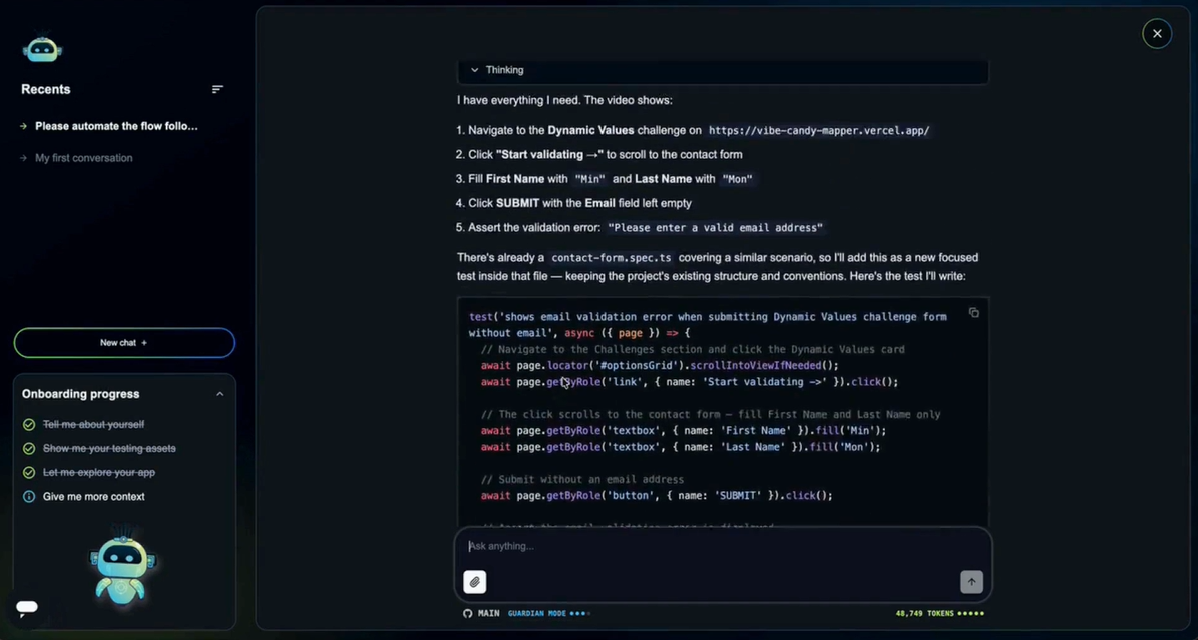
Flaky selectors and async loading race conditions are the two biggest reasons Playwright tests pass locally and fail in CI, and fixing them requires treating test generation as an ongoing diagnostic process, not a one-time script-writing task. Test generators and recorders that capture raw CSS or XPath selectors produce brittle tests when an application uses dynamic IDs or classes. The recommended fix is role-based locators and stable data-testid attributes, so the test has something durable to grab onto.. The second half of the problem, async loads, is less about selectors and more about timing: Playwright's built-in auto-wait mechanism and web-first assertions exist specifically so tests don't need hardcoded sleeps, yet teams still write them out of habit, and that habit is where most flakiness gets reintroduced.
TL;DR
- Most Playwright test flakiness traces back to two root causes: brittle selectors tied to dynamic DOM structure, and manual waits that fight Playwright's native auto-wait system.
- Recent QA benchmark data attributes 45% of flaky end-to-end test failures to async timing issues, with concurrency problems adding another 20% and brittle selectors cited as a primary contributor.
- Role-based and test-ID locators are more resilient than CSS/XPath because they target stable, user-facing attributes instead of implementation details that change on every redesign.
- Flaky tests aren't just an annoyance: they consume a meaningful share of CI time in reruns and eat into developer hours spent investigating false failures.
- Self-healing test automation can reduce the maintenance burden, but only if it diagnoses whether a failure is a real defect, a test issue, or an environment issue before it rewrites anything.
About this article: This guide draws on patterns observed across Playwright-based regression suites by the team behind Amikoo, an AI agent by MuukLabs that generates and maintains Playwright tests for fast-shipping engineering teams, with testing approaches informed by six years of applied QA work across web applications.
Why Do Playwright Tests Become Flaky in the First Place?
A flaky test is one that produces different results across runs without any change to the underlying code, and in Playwright suites this almost always comes down to one of two mechanisms: the selector stops matching the element it was meant to find, or the test interacts with an element before the application has finished its async work. Industry reports indicate that flaky tests account for 13% to 21% of CI build failures. These intermittent failures consume 15% to 30% of total CI time in reruns and cost developers up to 8% of their working time investigating failures that turn out to be nothing.
That cost is the real argument for fixing flakiness systematically rather than re-running a failed job and moving on. A test suite that cries wolf trains engineers to ignore red builds, which is precisely the moment a real regression slips through. Recent QA industry benchmarks attribute 45% of flaky end-to-end test failures to asynchronous wait and timing issues, with concurrency problems accounting for another 20% and brittle selectors cited as a primary contributor to instability. Selectors and timing aren't separate problems so much as two faces of the same one: both come from writing tests against a snapshot of the UI instead of against its behavior.
Why Do Dynamic Selectors Break So Easily in Generated Tests?
A dynamic selector is one tied to a DOM attribute that changes between builds, such as an auto-generated class name from a CSS-in-JS library or a numeric ID assigned at render time. Generated tests are especially prone to this because recorders capture whatever is in the DOM at the moment of recording, and if that happens to be a framework-generated string, the test locks onto a value with no guarantee of surviving the next deploy.
Playwright's CSS and XPath selectors offer precise DOM targeting, but that precision is also their weakness: they are fragile against dynamically generated elements that frequently change structure. Role-based and test-ID locators work better because they target stable, user-facing attributes, the kind a real user or screen reader would rely on, rather than implementation details a developer could rename tomorrow. Think of it like giving someone directions to your house using "the blue door past the oak tree" instead of "the third house from the left." House numbers can get reassigned when the block gets renumbered; the blue door is a property of the house itself.
- Prefer role-based locators (getByRole) over CSS classes whenever the element has a semantic role: button, link, heading.
- Add explicit data-testid attributes to components your team knows will change visually but shouldn't change behaviorally.
- Avoid nth-child or index-based selectors, since reordering a list in the UI silently breaks every test that depended on position.
- Treat selector choice as a code review item, not an afterthought, especially for tests a tool or coding agent generated automatically.
How Should Async Loads Be Handled in Playwright Without Manual Waits?
Building on the selector problem above, the second major source of flakiness is timing: a test tries to click, read, or assert against an element before the page has finished loading data, animating a transition, or resolving a network call. Playwright's official documentation recommends relying on its built-in auto-wait mechanism, which automatically waits for elements to become actionable, and using web-first assertions that retry until conditions are met. The explicit guidance is to avoid hardcoded timeouts or manual sleeps entirely.
The reason this matters mechanically: a fixed sleep(3000) assumes the slowest possible load time every single run, which is both too slow on fast runs and still too fast on a congested CI runner having a bad day. Auto-wait and retrying assertions instead poll the actual DOM state, so the test proceeds the instant the condition is true rather than on a guessed clock. This is also why Playwright is frequently positioned ahead of Selenium in comparisons of playwright vs selenium: Playwright's auto-wait is native to the API, while Selenium historically required engineers to hand-roll explicit wait conditions for the same reliability.
- Use await expect(locator).toBeVisible() instead of waiting a fixed duration and then asserting.
- Wait for the specific response a UI update depends on (for example, with page.waitForResponse), rather than waiting for the whole network to go idle.
- Avoid chaining multiple manual waits inside a single test step; each one is a guess, and guesses compound.
- Let retrying assertions do the polling rather than wrapping assertions in your own retry loop.
How Does Playwright Compare to Cypress for Handling Dynamic UI?
Stepping back from selector-level mechanics, a related but distinct question is which framework handles dynamic UI better out of the box. In the playwright vs cypress conversation, both tools ship built-in retry logic for assertions, but Playwright's architecture supports multiple browser contexts and parallel execution natively, which matters for teams running automated regression testing across a growing number of user flows. Cypress's same-origin and iframe handling historically required workarounds that Playwright handles more directly, which is one reason teams migrating legacy Cypress or Selenium suites often consolidate onto Playwright test automation rather than the reverse.
Neither framework eliminates flakiness by itself. A perfectly configured Playwright suite with brittle selectors and manual sleeps will still flake; the framework provides the tools, but someone still has to apply the selector and waiting discipline described above consistently across every generated test, which is harder than it sounds once a suite has hundreds of specs written by different people (or different AI coding agents) over time.
For teams where E2E testing has fallen on developers, that consistency is the hardest part to keep up. It's also the kind of work Amikoo takes over: it generates tests using role-based and test-ID locators and web-first assertions by default, and keeps them current as the application changes.
Can AI Fix Flaky Tests Without Hiding Real Defects?
A harder question follows once a suite is running in CI: when a test fails, is it a flaky selector, a timing bug in the test itself, a genuine product regression, or a broken staging environment? This is where ai test automation tools and self-healing test automation have started to matter, but healing a test blindly is not the same as diagnosing why it broke. A failure must be diagnosed first: product defect, test issue, or environment issue, before any repair happens. Repairing a test that was actually catching a real bug just deletes the evidence.
Amikoo approaches this as a diagnosis-first workflow rather than a one-size-fits-all autofix. When a generated test fails on a pull request, Amikoo's Repair Agent diagnoses which of the three failure categories applies and reports the evidence to the development team, updating the test itself only when the issue is genuinely a stale selector or an outdated flow, not when the application is behaving incorrectly. In internal benchmark testing comparing repair approaches against Playwright's native test healer, Amikoo's repair process showed a higher repair success rate and fewer iterations per fix; these figures are internal and benchmark-specific rather than independently verified, but they reflect the same diagnose-before-repair principle: a tool that heals without classifying the failure first is optimizing for green checkmarks, not correctness.
This matters more as teams lean on coding agents like Claude Code or Cursor to ship faster. Those agents write and review code quickly, but verifying that the resulting product still works as intended is a separate job. That's the gap Amikoo is built to close: it generates Playwright TypeScript tests directly in a team's own repository on every pull request, runs them and diagnoses each failure as a product defect, test issue, or environment issue, and reports real defects.
What's the Difference Between a Flaky Test and a Real Regression?
Building on the diagnosis point above, this distinction is worth making explicit because teams often conflate the two under CI pressure. A flaky test fails intermittently with no code change behind it; a real regression fails consistently because the application genuinely broke. The practical test: rerun the failing job three times with no code change. If it passes even once, you're usually looking at flakiness rather than a consistent regression. But intermittent doesn't always mean harmless: a race condition in the application itself can fail some runs and pass others. That's why the cause matters more than the pass rate.
Teams that skip this check tend to do one of two costly things: they ignore a real regression because "the tests are always flaky anyway," or they spend engineering hours debugging product code for a problem that was actually a brittle locator. Both failure modes get more expensive as suites grow, which is why classification before action, whether done by a developer or Amikoo's Repair Agent, is the step that actually saves time.
Frequently Asked Questions
What causes most Playwright flaky tests?
Most flakiness traces to brittle selectors tied to dynamic DOM attributes and to async timing issues where a test interacts with an element before the page finishes loading.
Should I ever use hardcoded waits in Playwright?
Playwright's documentation explicitly advises against hardcoded timeouts or manual sleeps in favor of auto-wait and web-first assertions that retry until conditions are met.
Is Playwright better than Selenium for dynamic UI?
Playwright's native auto-wait mechanism reduces the manual wait-handling that Selenium historically required, which is a key reason teams compare playwright vs selenium when modernizing a suite.
Can self-healing test automation make flakiness worse?
It can, if it repairs tests without first diagnosing whether the failure is a real product defect. Repair should always follow classification, not replace it.
What's the best locator strategy for a generated Playwright test?
Prefer role-based locators and explicit data-testid attributes over CSS classes or index-based selectors, since the former target stable, user-facing attributes.
Does Amikoo generate tests for existing untested features, or only new code?
Both. Amikoo maps critical user flows to surface coverage gaps in previously shipped, untested surface area, in addition to generating tests for new pull requests.
How long does Amikoo take to set up?
Developers connect their app and repository in about 30 minutes; from there, Amikoo generates and maintains tests automatically on every pull request.
About Amikoo
Amikoo is an AI agent by MuukLabs that owns end-to-end verification for web applications. Developers connect their app and repository in about 30 minutes. From then on, on every pull request, Amikoo understands the change, determines which user flows need verification, creates or updates standard Playwright TypeScript tests in the team's own repository, runs them, diagnoses each failure as a product defect, test issue, or environment issue, and reports real defects. It's built for fast-shipping teams, often using coding agents like Claude Code or Cursor, where E2E testing has fallen on developers and the current workflow can't keep up. Amikoo complements coding agents rather than replacing them: AI writes and reviews the code, Amikoo verifies the product actually works. It connects to GitHub and Azure DevOps, with Bitbucket and GitLab support in progress, with no proprietary runtime or lock-in. MuukLabs also offers MuukTest, an expert-backed services brand under the same parent company, for teams that want hands-on QA support alongside the platform.
If flaky selectors and async timing issues are eating into your release cycles, see how Amikoo handles diagnosis-first test generation and repair at https\://amikoo.ai/.