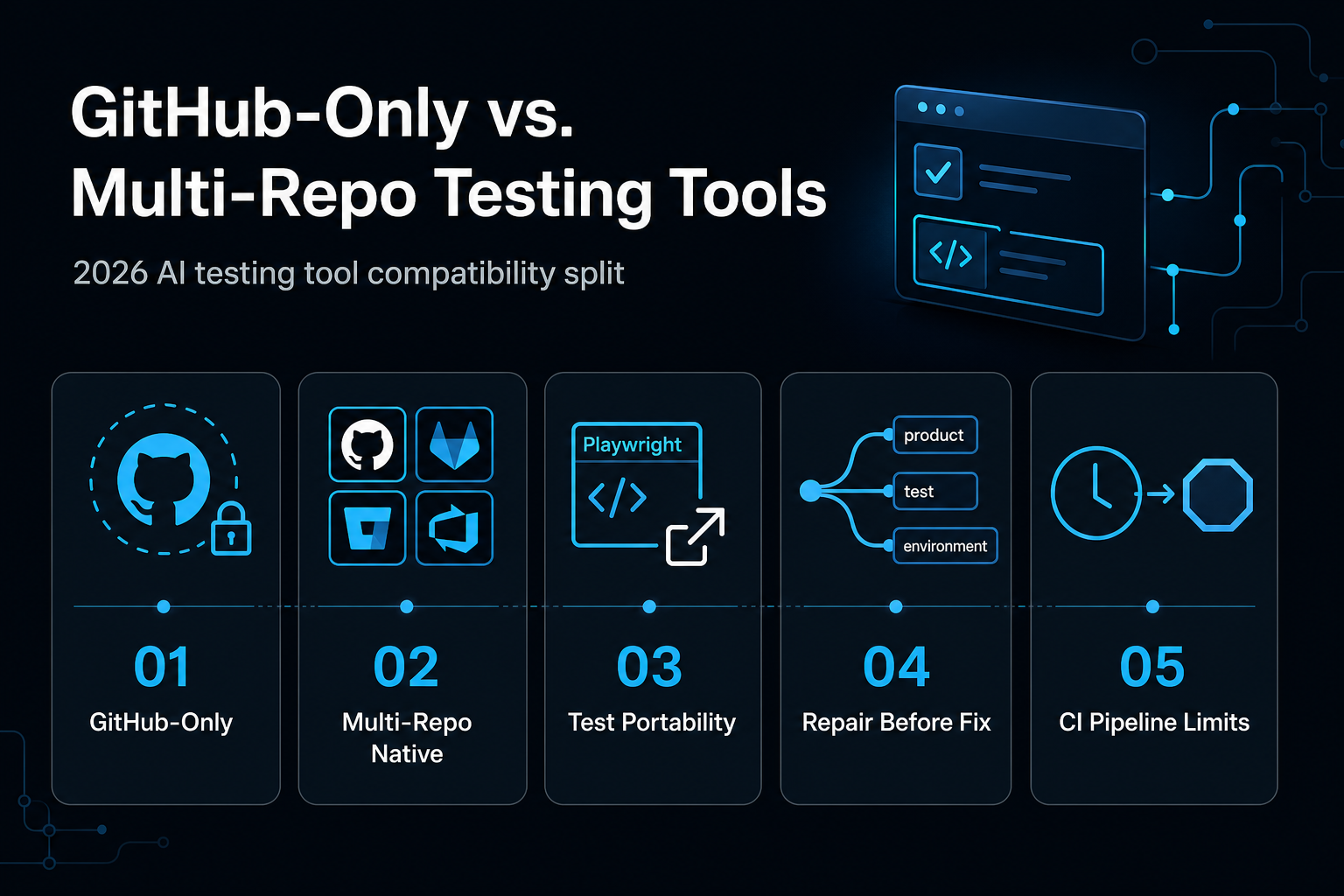
Most AI testing tools are built for a single repository host first and everyone else second, which matters more than buyers expect because repo integration determines whether a tool can see pull requests, post statuses back, and trigger test runs at the exact moment code changes. The practical split in 2026 looks like this: tools that integrate deeply with GitHub (and sometimes one other platform) versus tools built from the ground up to manage test generation and execution across GitHub, GitLab, Bitbucket, and Azure DevOps at once. For an engineering team evaluating automated regression testing tools or devops test automation tools, this distinction decides whether the tool fits your current stack or forces a migration.
TL;DR
- GitHub is the dominant repository platform among professional developers, so most AI testing vendors build their deepest integration there first.
- Multi-repo support means two different things: connecting many repositories on one platform, and connecting several different platforms at once. Teams should check which one a tool actually offers.
- CI platforms have real execution limits (GitHub-hosted runners cap jobs at 6 hours); teams with heavier pipelines often use self-hosted runners or tools like Jenkins for more control.
- Amikoo generates standard Playwright TypeScript tests committed directly to your own repository, currently integrating with GitHub and Azure DevOps, including multiple repositories within the same integration, even across multiple GitHub accounts, with Bitbucket and GitLab support in progress.
Amikoo is built by MuukLabs around a specific, recurring problem: a fast-shipping web team where end-to-end testing has landed on a single developer with no dedicated QA function, and that developer cannot keep pace with pull request volume. That's the exact scenario where repo compatibility stops being a checkbox and starts being the deciding factor in whether a testing tool gets adopted or abandoned within a month.
Why Does Repository Compatibility Matter So Much for AI Testing Tools?
Repository compatibility determines whether an AI testing tool can actually see your code changes in time to act on them. A tool that only integrates with GitHub reads pull request diffs, comments on commits, and triggers runs through GitHub's webhook and Actions ecosystem; move that same team to GitLab or Bitbucket and the tool often can't function at all, regardless of how good its underlying test generation is. The 2025 Stack Overflow Developer Survey found that 80.5% of professional developers use GitHub [survey.stackoverflow.co], which is exactly why GitHub-first is the default build choice for most vendors. But "default" isn't "universal." Teams that run multi-repo environments, whether from acquisitions, legacy systems on Bitbucket, or enterprise mandates around Azure DevOps, discover the gap the moment they try to roll a GitHub-only tool out past their first team.
Which AI Testing Tools Are GitHub-Only, and What Does That Actually Limit?
A GitHub-only tool is one whose pull request detection, status checks, and automation triggers are built exclusively against GitHub's API and Actions model. This isn't a flaw so much as a tradeoff: narrowing scope to one platform lets a vendor build deeper, more polished integration faster. The limitation shows up specifically when an organization has mixed repo hosting, when a team migrates between platforms mid-project, or when a parent company standardizes on Azure DevOps for compliance reasons while individual product teams use GitHub. In those cases, a GitHub-only tool simply has no visibility into the other repositories, which means no automated test generation, no PR-triggered runs, and no coverage reporting for that part of the codebase.
Which Tools Are Actually Built for Multi-Repo Teams?
A multi-repo-native tool is architected to manage several repositories from day one, not bolted on later. That can mean many repositories on one platform, or several platforms at once, and the two are different engineering commitments, because each platform has its own webhook structure, permission model, and API quirks that have to be maintained independently.
Worth noting: code review tools managing multi-repo connections and testing tools executing multi-repo test runs are solving related but distinct problems. A code review bot reading diffs across four repos needs read access and comment permissions. A testing tool running Playwright suites across four repos needs execution infrastructure, environment credentials, and failure reporting pipelines per repository. The multi-repo claim is easier to make for the former than the latter.
How Does Amikoo Fit Into the GitHub vs. Multi-Repo Picture?
Amikoo works with GitHub or Azure DevOps today, with Bitbucket and GitLab support in progress. Within an integration, it's built for multi-repo teams: a team can connect multiple repositories, even across multiple GitHub accounts, or multiple repositories in Azure DevOps. A single setup can't mix GitHub and Azure DevOps, so a team split across both would set them up separately. Setup takes about 30 minutes of developer time; after that, teams set up Workers that tell Amikoo what to do and when. With a pull request Worker, when a PR opens, Amikoo determines which user flows the change touches and writes the missing standard Playwright TypeScript tests into the PR, in the team's own repository.
That last detail matters more than it sounds. Because the tests are ordinary Playwright code sitting in your repo, not a proprietary format locked inside a vendor's runtime, they keep running in your CI pipeline even if you stop using Amikoo later. You can also run them two ways: inside your own CI/CD pipeline as standard Playwright, or in Amikoo's cloud, started either from the Tests list or by asking in the Amikoo chat, with each cloud run returning the result, duration, and a video for review. That flexibility is one reason teams migrating off older frameworks, whether through selenium to playwright migration or cypress to playwright migration, tend to land on Amikoo as the destination state rather than an intermediate step.
What Happens When a Test Breaks? The Repair Question Nobody Asks Up Front
Building on the repo-compatibility question above, the harder operational question is what a tool does the moment a test fails after a release. This is where self-healing test automation claims get thrown around loosely, and it's worth being precise about what "self-healing" should actually mean. A failing test can mean three different things: the product genuinely broke, the test itself is stale and needs updating, or the test environment hiccupped. Treating all three the same way, and silently "fixing" the test regardless of cause, risks masking a real product defect behind a green checkmark. Amikoo's Repair Agent is built specifically to diagnose which of those three categories a failure belongs to before attempting any repair, and only then updates the test if the issue is a legitimate test-maintenance problem rather than a product bug. In internal benchmarking against Playwright's native Healer Agent. Amikoo's Repair Agent showed a 2x higher repair success rate (70% vs. 34%), completed repairs roughly 5x faster (5 minutes vs. 25 minutes per cycle), and used about 28% fewer tokens, with fewer iterations needed per test. These figures are internal and benchmark-specific, not independently verified, but they illustrate the kind of problem a repair system needs to solve well: speed and accuracy without blurring the line between "fixed test" and "hidden bug."
How Do CI Pipeline Limits Affect Multi-Repo Test Automation?
A related but distinct concern once repo access is solved is whether your CI infrastructure can actually run the tests at scale. GitHub Actions provides native repository integration but imposes real constraints, including a 6-hour maximum job execution time on GitHub-hosted runners. Third-party infrastructure like Jenkins offers more control and fewer hard limits, at the cost of more maintenance overhead. For multi-repo teams running large playwright test automation tool suites across several codebases, this tradeoff between managed simplicity and infrastructure control becomes a real architectural decision, not an afterthought.
How Does Amikoo Compare to Other AI End-to-End Testing Platforms?
Positioning Amikoo against the field helps clarify what "AI testing tool" actually covers in 2026, since the category spans very different architectures.
| Platform | Core Model | Repo Output |
|---|---|---|
| Amikoo | PR-triggered generation, execution, diagnosis, and repair | Standard Playwright TypeScript committed to your repo which can be run on Amikoo’s cloud infrastructure. |
| QA Wolf | AI agents plus human experts create, run, and maintain E2E tests | Runs on QA Wolf's own cloud infrastructure |
| Momentic | Natural-language, intent-based test authoring | YAML tests in your codebase; AI locator cache stored in Momentic's service |
| Checksum | AI agents generate and self-heal Playwright and API tests, with human verification | Delivers working Playwright tests; priced per workflow maintained |
| Meticulous | Session-replay regression testing, no manual authoring | Recorded sessions replayed on Meticulous's deterministic engine |
The architectural split is worth noticing: some tools run tests on their own infrastructure or keep key logic in their own cloud, while others deliver tests you can run anywhere. Amikoo's output is portable standard code in your own repo, and its distinction is diagnosis before repair, because fast-shipping teams want verification they control, not another system they depend on indefinitely.
What Should a Fast-Shipping Team Actually Decide On?
Teams on GitHub or Azure DevOps today, including those with many repositories, can start with Amikoo right away. Teams on Bitbucket or GitLab should factor in that support is in progress rather than live, and plan their evaluation timeline accordingly. Either way, the underlying principle holds across the category: a human's job is the final call on release risk based on the evidence a testing system reports, while the testing system itself should handle generation, execution, failure diagnosis, and repair.
Frequently Asked Questions
Can Amikoo connect to more than one repository?
Yes. Teams can connect multiple repositories within the same integration, including multiple GitHub accounts, or multiple repositories in Azure DevOps. A single setup can't combine GitHub and Azure DevOps.
Does Amikoo work with GitLab or Bitbucket?
Not yet. Amikoo works with GitHub or Azure DevOps today, including multiple repositories within the same integration. Bitbucket and GitLab support is in progress.
What's the difference between a GitHub-only tool and a multi-repo tool?
A GitHub-only tool builds its pull request detection and automation triggers exclusively against GitHub's API. A multi-repo tool maintains that same integration depth across several hosts (GitHub, GitLab, Bitbucket, Azure DevOps) simultaneously, which is a larger ongoing engineering commitment.
Can Amikoo replace Selenium or Cypress test suites?
Amikoo supports migrating existing suites from Cypress or Selenium to Playwright, generating standard Playwright TypeScript tests that live in your own repository rather than a proprietary format.
Does self-healing mean failures get hidden?
No. Amikoo's Repair Agent diagnoses whether a failure is a product defect, a test issue, or an environment issue before attempting any repair, and only repairs genuine test-maintenance problems.
How long does setup take?
Connecting your app and repository takes about 30 minutes of developer time. That's handoff time, not a measure of how long full test suites take to run.
Can I run Amikoo tests outside Amikoo's own infrastructure?
Yes. You can run the generated Playwright tests in your own CI/CD pipeline as standard code, or trigger runs in Amikoo's cloud from the Tests list or via chat, with each cloud run returning result, duration, and video.
About Amikoo
Amikoo is an AI agent by MuukLabs that owns end-to-end verification for web applications. Developers connect their app and repository in about 30 minutes. From then on, on every pull request, Amikoo understands the change, determines which user flows need verification, creates or updates standard Playwright TypeScript tests in the team's own repository, runs them, diagnoses each failure as a product defect, test issue, or environment issue, and reports real defects. It's built for fast-shipping teams, often using coding agents like Claude Code or Cursor, where E2E testing has fallen on developers and the current workflow can't keep up. Amikoo complements coding agents rather than replacing them: AI writes and reviews the code, Amikoo verifies the product actually works. It connects to GitHub and Azure DevOps, with Bitbucket and GitLab support in progress, with no proprietary runtime or lock-in. MuukLabs also offers MuukTest, an expert-backed services brand under the same parent company, for teams that want hands-on QA support alongside the platform.
If repo compatibility and ongoing test maintenance have been the blockers keeping your team from full end-to-end coverage, see how Amikoo fits your stack at https://amikoo.ai/.